Learn — By WATMM Desk —
Publishing admin vs a co-pub or full publishing deal: what each costs and what you get
An admin deal charges a percentage and leaves your copyright with you. A co-pub or full publishing deal can pay an advance, but you give up part of the copyright, often for years after the contract ends. Here is how to compare the two on cost, control and time.
Key facts
- Admin example: Songtrust lists a \$100 one-time fee per songwriter, 15% of performance royalties and 20% of non-performance royalties, and says copyright ownership stays with you.
- Publishing deals: the US Copyright Office describes the writer assigning a portion of the copyright, "traditionally 50%, but sometimes less", in exchange for services and possibly an advance against future royalties.
- Time: the UK Competition and Markets Authority found publishers can keep rights for anywhere between five and twenty-five years after a contract term ends.
If you write songs, sooner or later someone offers to "handle your publishing". That phrase covers two very different trades. An administration (admin) deal is a service: someone registers your songs and collects your royalties for a fee. A co-publishing (co-pub) or full publishing deal is a sale of part of your copyright, usually in return for an advance and the publisher's work on your songs. This guide compares them on three things: what you pay, what you get and how long it lasts.
This is a general guide, not legal advice. The percentages below are one published example and worked arithmetic, not market rates.
We already have a longer news explainer on the three deal types and 2026's catalogue sales. This page is the short decision version.
The starting point: two halves of the money
Before any deal, songwriting performance income is split in two. ASCAP's membership FAQ says that when it pays for a performance, 50% goes to the writer(s) and 50% to the publisher(s). ASCAP also says a writer who has not assigned their publishing rights to anyone can take out a publisher membership and collect the publisher's share themselves. If you want the full picture of what PROs do and don't collect, see our PRO guide.
Every deal in this guide is really a deal about that publisher's half, plus the other income types (mechanicals, sync) a publisher or administrator handles.
Admin: what it costs and what it gives
What you pay. A commission on what the administrator collects, sometimes plus a sign-up fee. As one published example, Songtrust's pricing page lists a $100 one-time fee per songwriter, an administration fee of 15% on performance royalties and 20% on non-performance (worldwide mechanical) royalties. Other administrators price differently, so compare the page of whoever you are considering.
What you keep. Ownership. Songtrust says it "leaves copyright ownership and creative control" with you.
What you get. Registration and collection. Admin is paperwork done at scale. Don't count on an advance, creative work or sync pitching unless the contract says so.
How long. Check the exit terms. Songtrust's page says that if you cancel, a one-year post-term collection period applies to royalties earned while your account was active. Other providers' terms differ.
Co-pub and full publishing: what they cost and what they give
What you pay. Part of the copyright. The US Copyright Office's 2015 music report describes a publishing agreement like this: the songwriter assigns "a portion of the copyright" in the songs written during the term, "traditionally 50%, but sometimes less". In a co-pub, in our reading, the publisher's half is shared between you and the publisher rather than handed over whole.
What you get. The same report says the publisher may pay an advance against future royalties, and promotes and licenses the songs and collects the royalties. An advance is recouped from your royalties, so it is a prepayment, not a bonus. Our record deal red flags guide covers the same recoupment logic on the label side.
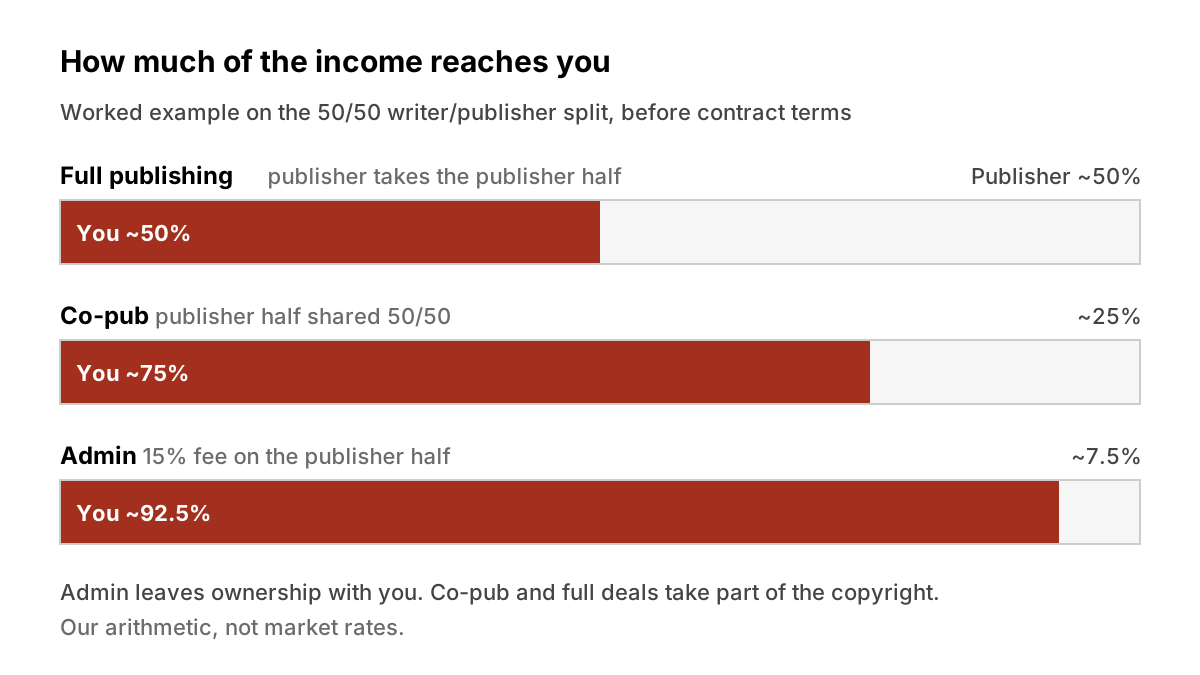
The rough arithmetic (our worked example). Take the 50/50 split above and ignore admin fees in the contract:
- Full publishing: the publisher takes the publisher's half; you keep the writer's half. Roughly 50% of the income reaches you.
- Co-pub, 50/50 on the publisher's half: you keep the writer's half plus half of the publisher's half. Roughly 75% reaches you, 25% stays with the publisher.
- Admin with a 15% fee on the publisher's half only: roughly 92.5% reaches you, and you still own the song. The Copyright Office report notes that, by longstanding practice, PROs pay the writer's share to songwriters directly, so in this example the fee doesn't touch it.
Real contracts define "income", fees and deductions in their own ways, and those definitions decide the true numbers. Treat this as a way to read an offer, not a forecast.
How long. This is the cost that's easy to miss. The UK Competition and Markets Authority's 2022 music and streaming report found that a songwriter contract's term is an initial period plus options the publisher decides whether to take up, and that publishers' rights can run anywhere between five and twenty-five years after the contract ends. It also noted that some publishers ask for an assignment only for a limited "retention period", after which the songs come back. Our guide to the two copyrights in every song explains which copyright is at stake here.
A quick side-by-side
| Admin | Co-pub | Full publishing | |
|---|---|---|---|
| You give up | A fee on collections | Part of the publisher's share of the copyright | The publisher's share of the copyright |
| Advance | Not usually | Possible | Possible |
| Creative or sync work | Only if the contract says so | Depends on the publisher | Depends on the publisher |
| How long it binds you | Set by the exit terms | Term plus options plus any retention period | Term plus options plus any retention period |
What we think
For most independent writers, admin is the sensible default, and registering as your own publisher at your PRO comes before even that. A percentage you can walk away from is a cheaper mistake than a share of a copyright you can't get back for years.
A co-pub or full deal can be worth it, but only for what the publisher adds beyond collection: an advance you actually need, real pitching, introductions to co-writers. Our test is simple. Strip out the advance and ask what the publisher does that an administrator wouldn't. If the answer is "not much", you'd be paying with ownership for a service sold elsewhere for a commission.
When you do compare offers, compare them over time, not on the cheque. Add up the term, the options and the retention period, and set the advance against the years your share is away. A smaller advance with a short retention period can be the better deal.
Questions to ask before signing
- Does this deal take ownership, or only the right to administer?
- What is the fee or split on each income type, and how is "income" defined?
- How many option periods are there, and who decides on them?
- How long is the retention period after the term, and do songs revert automatically?
- Is the advance recoupable from all income or only some?
- Who registers the songs with your PRO, The MLC and overseas societies, and can you see those registrations?
- Get a music lawyer to read anything that takes a share of your copyright.
Sources
- Pricing, terms and FAQs, Songtrust (primary source). Accessed 24 Oct 2026.
- ASCAP membership FAQ, ASCAP (primary source). Accessed 23 Oct 2026.
- Copyright and the Music Marketplace (February 2015), U.S. Copyright Office (primary source). Accessed 23 Oct 2026.
- Music and streaming: final report (29 November 2022), Competition and Markets Authority (primary source). Accessed 23 Oct 2026.
Researched with AI assistance, written and checked by WATMM Desk.