Learn — By WATMM Desk —
Mechanical royalties and the MLC: how independent songwriters claim them, in the US and beyond
Every stream of your song in the US earns a mechanical royalty, and your distributor and your PRO do not collect it. Here is what a mechanical is, how a self-administered writer joins the MLC and registers or claims works in its portal, what MCPS and CMRRA do outside the US, and the order we would do it in.
Key facts
- The MLC administers the US blanket licence for downloads and interactive streams, in effect since 1 January 2021. CDs and vinyl still run on song-by-song licences.
- MLC membership is free, needs no company, and does not replace your PRO. Owners must register with the MLC even if the song is registered with the Copyright Office.
- Outside the US: in the UK, MCPS is a separate membership from PRS with its own one-off joining fee; CMRRA (Canada) accepts self-published writers who do not live in Canada and charges 5% on what it collects from the MLC.
If you write your own songs and release them through a distributor, there is a good chance you are missing one royalty entirely. Your distributor pays you for the recording. Your PRO pays you when the song is performed. Neither collects the mechanical royalty that every US stream and download of your song also earns.
This guide is about that money: what it is, how a writer without a publisher collects it from the Mechanical Licensing Collective (the MLC), and who does the same job in the UK and Canada. It is a practical guide, not legal advice, and everything is as we read it on 24 Oct 2026. For the map of every royalty and every body, see who pays you for what. Here we stay on one line and go step by step.
What a mechanical royalty is
A song (the composition: melody and lyrics) and a recording of it are two different copyrights. A mechanical royalty is paid to the song's owners when the song is reproduced: pressed on a CD or vinyl, sold as a download, or streamed on demand.
In the US this runs on a compulsory licence in 17 U.S.C. § 115, covering the making and distribution of recordings of musical works. The Music Modernization Act created a blanket licence for digital services covering permanent downloads, limited downloads and interactive streams. The services get it by filing one notice with the MLC instead of licensing song by song. The blanket licence took effect on 1 January 2021.
Two limits matter:
- It is US only and digital only. Physical formats still use the old song-by-song notice system, according to the Copyright Office FAQ. Royalties from streams in other countries are paid there.
- It is not your performance royalty. The same stream also earns a performance royalty, which your PRO collects. The MLC says joining it "does not replace other memberships" and that the two pay different types of royalties.
Spotify's own artist help says it plainly: song royalties go to "publishers, collecting societies, and mechanical agencies based on the territory of usage", and songwriters can claim mechanicals from all digital music providers, including Spotify, through the MLC Portal.
Who the MLC is, and why it holds your money
The Copyright Office designated the MLC to run the blanket licence. Its running costs are paid by the digital music providers, through voluntary contributions and an assessment set by the Copyright Royalty Judges, which is why membership costs writers nothing.
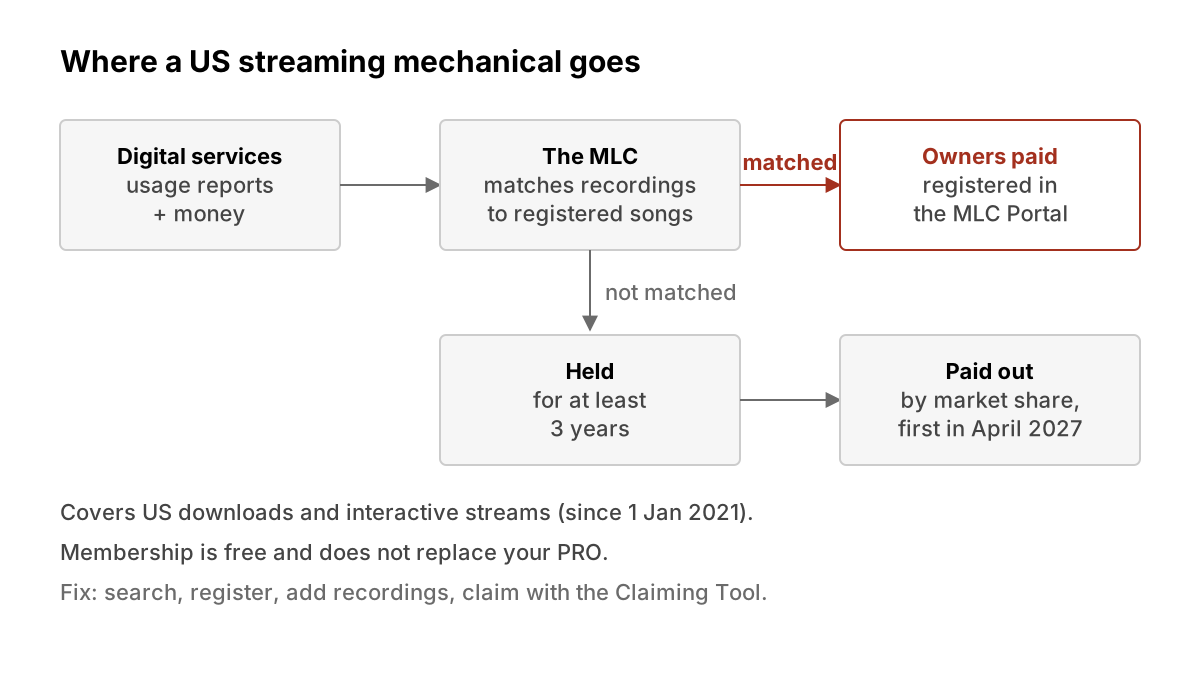
The services send the MLC usage reports and money. The MLC then has to match each recording to a registered song and its owners. If it can't, the money waits. The law says unmatched royalties must be held for not less than 3 years and then paid out to copyright owners by relative market share.
That point is close. On 30 Sep 2026 the MLC announced that its first market-share distribution will be in April 2027, starting with unclaimed royalties from January 2021 usage and moving forward one usage month at a time. The same release reports more than $4.2 billion distributed, more than 100,000 members and a match rate above 92%. We covered what that schedule means for old money in our piece on market-share payouts.
Do you need to join?
The MLC says anyone entitled to collect US digital audio mechanical royalties should join, and names three groups: self-administered songwriters, publishers and administrators, and collecting societies.
You are self-administered if you have kept the right to register your own works. That is most independent writers who have not signed a publishing or admin deal. If you have signed one, your publisher or administrator registers your songs, and you should check with them rather than register the same songs yourself.
A US copyright registration does not do the job for you. The Copyright Office says owners must still register with the MLC to receive these royalties.
You also don't need a company. The MLC says you do not need to form a partnership, corporation or LLC before joining. Membership is free.
How to join and claim, step by step
- Become a member. Start from the MLC's Get Started page. Membership gives you the Member Hub in the MLC Portal.
- Search before you register. The registration guide asks you to search with at least two criteria, such as title and writer name, and create a new work only if there is no exact match. A song can already be there if a co-writer's publisher registered it.
- Register the work. Only the title is required, but each work needs at least one composer or author. Search for each co-writer by name or IPI number, or create them.
- Enter your share. A self-administered writer can list their own member as the publisher. Each collection share must be between 0.01% and 100%.
- Add recordings. Optional, but the MLC says current works and recording data in the Member Hub help it match royalties to your songs. Only the recording title and artist name are required.
- Claim shares on songs already registered. If someone else registered the song and shares remain, use the Claiming Tool to claim yours. If the registered shares already add up to 100% and that is wrong, you can submit an overclaim.
- Hunt for unmatched usage. The Claiming Tool is how you search unmatched recording usage and claim royalties for your works. Then check your statements for uses you were not paid for.
Repeat steps 2 to 5 for every new release. We would do it in release week. Matching runs on the data you give it, and a co-writer, featured artist or alternate spelling missing from your registration is how songs end up unmatched.
Outside the US
Writers outside the US face two questions: who collects at home, and who collects your US mechanicals.
United Kingdom: MCPS. PRS for Music runs two separate memberships: PRS for performance and MCPS for mechanical (reproduction) rights. Each charges its own one-off joining fee; check the current fees on PRS for Music's joining page before you sign up, because we could not confirm them from a page we could load.
Canada: CMRRA. CMRRA represents the reproduction right in Canada across streaming, downloads, CDs and vinyl. It is open to anyone who owns or administers musical works in Canada, you don't need to live there, and a writer who has not assigned their songs to anyone can join as a self-published songwriter. It also collects from the MLC and IMPEL, charging a 5% administration fee on those international collections.
Everywhere else. Collecting societies can join the MLC on their members' behalf, and the MLC publishes a list of societies already connected. If yours is on it, ask whether it collects your US digital mechanicals before you join the MLC directly. Registering the same share twice, through your society and yourself, risks a conflict that can hold up the money. The MLC's own answer for non-US writers is that it depends on your business relationships and any rights you have granted.
We could not find published, citable rules from India's societies on collecting streaming mechanicals for self-published writers, so we have left India out. If you are an IPRS member, ask them in writing who collects your US mechanicals.
What we think
The MLC is the best deal in music admin for an independent writer. It is free to join, and you don't need a company. For a writer whose catalogue earns small sums, joining yourself is a sensible first step, as long as you will actually register every release.
The weak point is that the system works best for people who already have good data. Matching depends on registrations, the unclaimed pool goes out by market share, and the first payout from that pool is six months away. That design rewards the big catalogues that register everything. The fix for an independent writer is dull but it works: register in release week, put every co-writer on the work, and check your statements.
Outside the US, the costs are less even. A UK writer pays two separate one-off joining fees to collect both lines, while the US and Canadian routes cost nothing to join. That is not a reason to skip MCPS if your songs sell or stream. It is a reason to work out what you earn before you pay.
Checklist
- Confirm whether you are self-administered. If you have a publishing or admin deal, stop and ask them.
- Join your PRO for performance royalties. It does not cover mechanicals.
- Join the MLC (free), or confirm your home society collects US digital mechanicals for you. Not both for the same share.
- Search, then register every song with every co-writer and your share.
- Add each recording's title and artist.
- Use the Claiming Tool for songs others registered and for unmatched usage.
- UK: consider MCPS. Canada: consider CMRRA.
- Repeat for every release.
Sources
- Title I: Musical Works Modernization Act, US Copyright Office (primary source). Accessed 24 Oct 2026.
- Music Modernization Act FAQ, US Copyright Office (primary source). Accessed 24 Oct 2026.
- 17 U.S.C. § 115, Legal Information Institute, Cornell Law School (primary source). Accessed 24 Oct 2026.
- Royalties, Spotify for Artists (primary source). Accessed 24 Oct 2026.
- Membership, The MLC (primary source). Accessed 24 Oct 2026.
- Self-Administered Songwriters, The MLC (primary source). Accessed 24 Oct 2026.
- How to register works in The MLC Portal, The MLC Help Center (primary source). Accessed 24 Oct 2026.
- Royalty income tracking, The MLC (primary source). Accessed 24 Oct 2026.
- The MLC holds Annual Membership Meeting, announces date of first monthly market share distribution, The MLC (primary source). Accessed 24 Oct 2026.
- Join, PRS for Music (primary source). Accessed 24 Oct 2026.
- FAQ, CMRRA (primary source). Accessed 24 Oct 2026.
Researched with AI assistance, written and checked by WATMM Desk.