Learn — By WATMM Desk —
Two copyrights in every song: composition vs sound recording, who owns each, and how to register
Every recorded song carries two copyrights: one in the composition (music and lyrics) and one in the sound recording (the master). Here is who owns each by default under US law, how work-made-for-hire and transfers change that, and the registration basics that decide what you can do if someone copies you.
Key facts
- Two works: the US Copyright Office says sound recordings and musical compositions "are considered two separate works for copyright purposes" (Circular 56A).
- Default owner: copyright initially belongs to the author who created the work, and exists automatically once the work is fixed; work made for hire is the main exception (Circular 1).
- Registration: not mandatory, but needed before suing over a US work, and statutory damages and attorneys' fees need registration before infringement or within three months of publication (Circular 1). Electronic fees are $45 (Single Application) or $65 (Standard Application).
Every recorded song you release contains two copyrights, not one. One covers the song: the music and the words. The other covers the recording: the particular sounds you captured. They can have different authors, different owners and different registrations, and most of the money questions in music (who gets publishing, who gets master royalties, who has to clear a sample) come back to this split.
This is a practical guide to US law as we read it on 24 Oct 2026, based on the US Copyright Office's own circulars. It is not legal advice, and other countries differ in the details.
What are the two copyrights?
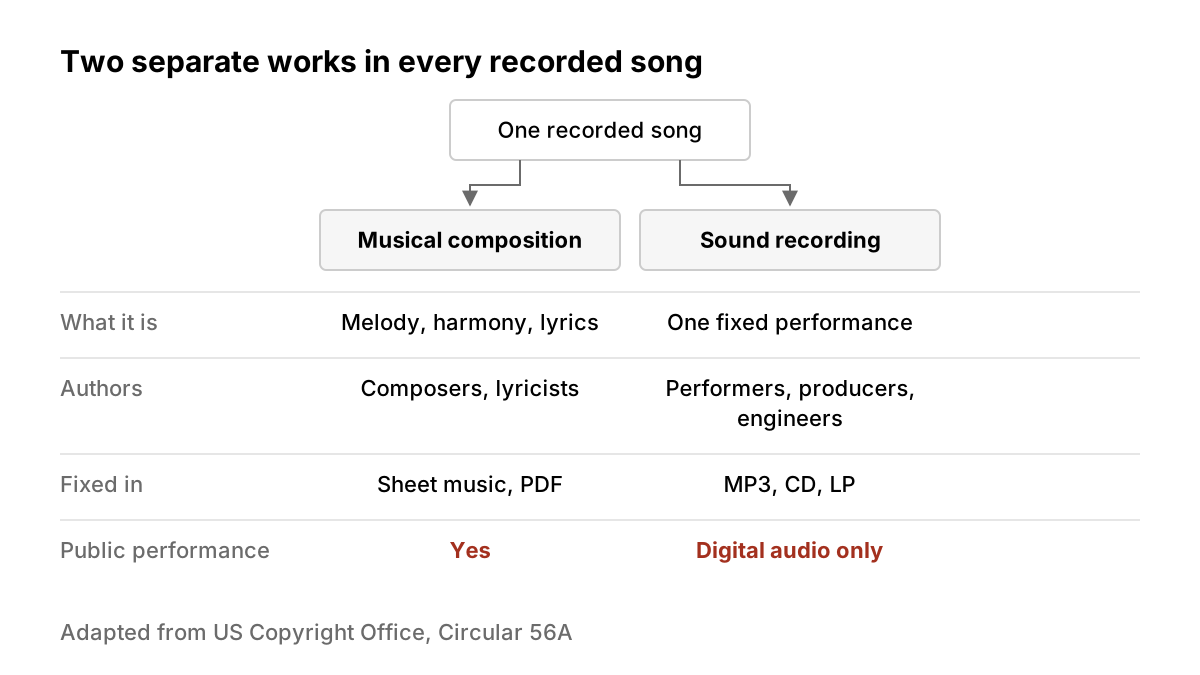
The Copyright Office's Circular 56A puts it plainly: sound recordings and musical compositions "are considered two separate works for copyright purposes." It adds that even though a recording is a derivative of the song underneath it, a copyright in the recording "is not the same as, or a substitute for," copyright in the composition.
| Musical composition | Sound recording | |
|---|---|---|
| What it is | Melody, rhythm and/or harmony, plus any lyrics | A fixation of a series of sounds, such as one particular performance |
| Authors (per the Office) | Composers, lyricists, songwriters | Performers, producers, sound engineers |
| Fixed in | A copy (sheet music, print or PDF) | A phonorecord (MP3, CD, LP) |
| Public performance right | Yes | Only by digital audio transmission |
The table above is adapted from Circular 56A. The Office's example is "Respect": the composition and a recording of Aretha Franklin singing it "are two distinct works."
That performance row matters more than it looks. Circular 56A lists public performance as an exclusive right for compositions, but for sound recordings only "by means of a digital audio transmission". In practice, that gives the song's owner a broader performance right than the recording's owner, so the two sides do not earn from the same places.
Who owns each one by default?
The starting rule: whoever made it
According to Circular 1, copyright "exists automatically from the moment the original work of authorship is fixed," and it "initially belongs to the author(s) who created that work." You do not file anything to get it. A voice memo of a new melody is fixed; so is a bounce of your session.
Who counts as the author differs between the two works. Circular 56A says the author of a composition is "the person who created the music and/or lyrics." The author of a sound recording is the featured performer or performers "and/or the producer(s) who captured and/or manipulated or edited the sounds." So the bedroom producer who writes, plays and mixes a track alone is the default author of both works. A band that writes together and records with an outside engineer may have a different set of people on each side.
Co-writers share the whole song
When two or more people make a single work intending their parts to merge "into inseparable or interdependent parts of a unitary whole," Circular 1 says they are joint authors with "an indivisible interest in the work as a whole." In plain terms, co-writers do not each own "their" verse; they share the song. How they split income is something to agree on paper, which is what a split sheet is for (more in our guide to metadata, ISRCs, ISWCs and split sheets).
Work made for hire: the big exception
Circular 1 calls works made for hire "an important exception." When a work is made for hire, "the party that hired the individual is considered the author and the copyright owner." There are two routes:
- The work is made by an employee as part of their regular duties.
- The work is specially commissioned for one of nine listed uses (including a contribution to a collective work, part of a motion picture or other audiovisual work, and a compilation) and both sides sign a written agreement saying it is a work made for hire.
Note what the second list in Circular 1 does not include: sound recordings and songs are not named as categories of their own. Whether a particular record deal or session contract actually creates a work made for hire is a legal question, and Circular 56A says it is the applicant, "not the U.S. Copyright Office," that must decide whether a work meets the definition. If a contract you are signing uses the phrase, get it read.
Transfers: where labels and publishers come in
Most labels and publishers own copyrights because the creators transferred them, not because they wrote anything. Circular 1 says rights can be transferred in whole or in part, but a transfer "generally must be made in writing and signed by the owner." A non-exclusive licence does not need a written agreement.
So the typical picture, a label holding the master and a publisher holding some share of the composition, is a contract outcome, not a default. If you have signed nothing, you probably still own what you made. Circular 1 also notes that buying a copy of a recording does not give you any ownership of the copyright in it.
Two more points from Circular 1 that artists tend to miss:
- Termination. Under certain circumstances, authors or their heirs can terminate a transfer or licence after 35 years, by serving advance written notice and recording it with the Office on time.
- Term. For works created since 1 Jan 1978, copyright generally lasts the author's life plus 70 years (70 years after the last surviving author for joint works). For works made for hire it is 95 years from publication or 120 from creation, whichever is shorter.
How do you register?
Do you need to?
Not to own it. Circular 1 says registration "is not mandatory." But for US works, registration (or a refusal) is "necessary to enforce the exclusive rights of copyright through litigation." It also lists other benefits:
- Registration made before or within five years of publication is prima facie evidence that the copyright is valid.
- If you register before the infringement starts, or within three months after publication, you are eligible for statutory damages, attorneys' fees and costs.
- You can register at any point during the copyright's life, and registering before release means you do not have to re-register on publication.
The three-month window is the one to plan around. Without registration in time, you can still sue once registered, but the remedies that make small cases worth bringing are off the table.
One application or two?
Because the works are distinct, Circular 56A says separate applications "generally should be submitted for each work." But you may use one Standard Application for both when the composition and recording are on the same phonorecord and the claimant for both is the same. The Office's examples:
- You recorded someone else's song: you (or your label) register the recording only.
- Someone else recorded your song: you (or your publisher) register the composition only.
- You wrote and recorded your own song: you may file one application for both.
There is also the cheaper Single Application, which covers one recording plus its underlying composition only if all three conditions are met: both are on the same phonorecord, the author is the only performer featured, and the author is the only owner of both works. If anyone else is featured or co-owns either side, it does not fit.
The Office's fee schedule lists electronic filing at 65 for the Standard Application.
Practical notes from Circular 56A
- Pick "Sound Recording" as the type of work when one application covers both; picking the wrong type means starting over.
- Name the authors of both works, or the employer if it was a work made for hire.
- If the claimant is not the author, add a transfer statement saying how they got the rights.
- Use the limitation of claim section if the work includes an appreciable amount of previously published, previously registered, public domain or third-party material, such as a cleared sample.
- For unpublished or digital-only releases, the Office "strongly encourages" uploading the deposit online; each file must be under 500 MB.
- Up to ten unpublished recordings and their compositions can go on one group application, but only if the same authors made all of them and all are named as claimants.
If the song came out of an AI-assisted workflow, registration has its own disclosure questions; see our guide on how to register an AI-assisted song.
What we think
The two-copyright split is the most useful single idea an independent artist can learn, because it tells you what you are actually signing away. A distribution deal, a label deal and a publishing deal are each claims on one side of this table, or on income from it. Read every contract by asking: which of the two works is this about, is it a transfer or a licence, and for how long?
Our view is that artists should register their own work, early and on both sides, before release. Missing the three-month window makes even a clear-cut infringement expensive to pursue. Self-releasing writer-performers can often use the cheapest route, and they should, because the Single Application exists for exactly them.
We are also wary of "work made for hire" language turning up in contracts aimed at session players, beatmakers and toplineers. The statute's list is narrow, and the Office itself says the applicant decides whether a work qualifies, which leaves room for contracts to claim more than they should. If you contributed to the song or the recording, ask in writing which side you have a share of, and keep the answer with your split sheet. And when you are the one borrowing, remember the same split runs the other way: a sample touches both works, as we cover in sample clearance basics.
FAQ
Do I own the copyright as soon as I record my song? Under US law, yes, by default: copyright exists from fixation and belongs to the author, unless it was a work made for hire or you transferred it in a signed writing.
Is the composition copyright the same as "publishing"? Broadly, in our own shorthand: when people in music say "publishing" they usually mean the composition side, and "the master" usually means the recording side. The Copyright Office does not use those terms; it treats them as two separate works that are registered separately (Circular 56A).
Can I register a song and its recording together? Yes, on one Standard Application, if both are on the same phonorecord and the claimant for both is the same. A solo writer-performer who owns both can use the Single Application.
Do I have to register to be protected? No, but you need registration (or a refusal) before suing over a US work, and you need it early to qualify for statutory damages and attorneys' fees.
Sources
- Circular 56A: Copyright Registration of Musical Compositions and Sound Recordings, US Copyright Office (primary source). Accessed 24 Oct 2026.
- Circular 1: Copyright Basics, US Copyright Office (primary source). Accessed 24 Oct 2026.
- Fees, US Copyright Office (primary source). Accessed 24 Oct 2026.
Researched with AI assistance, written and checked by WATMM Desk.