Learn — By WATMM Desk —
Performing rights organisations explained: what ASCAP, BMI, PRS, GEMA and IPRS collect, and what they leave on the table
A performing rights organisation (PRO) licenses the public performance of songs and pays the writers and publishers. Here is what that covers, how joining works at the big societies in the US, UK, Germany and India, and the income streams a PRO will never collect for you.
Key facts
- One right, mostly: BMI calls public performance "the only royalty that BMI pays", and SoundExchange says it "does not currently collect or distribute royalties for songwriters or publishers".
- Joining costs vary: PRS charges writers a one-off £100 (£30 if under 25); GEMA charges creators a €90 admission fee plus VAT and €50 a year, with the admission fee waived for applicants aged 30 or under.
- Not every society is the same shape: GEMA administers mechanical and online rights alongside performing rights, while in the UK mechanicals sit with a separate society, MCPS.
Every time a song you wrote plays on the radio, in a gym, in a bar or on a streaming service, somebody owes the songwriter money. Nobody can chase that money one venue at a time, so writers hand the job to a performing rights organisation, a PRO (outside the US usually called a collecting society). This guide explains what a PRO collects, how you join the main ones in the US, UK, Germany and India, and the money a PRO does not touch.
It is a practical guide, not legal or tax advice. Fees and rules are as we read them on the societies' own pages on 24 Oct 2026, and they change, so check before you pay.
What a PRO actually does
A song has two copyrights in it, the composition (melody and lyrics) and the recording. A PRO deals only with the composition, and mostly with one right in it: public performance.
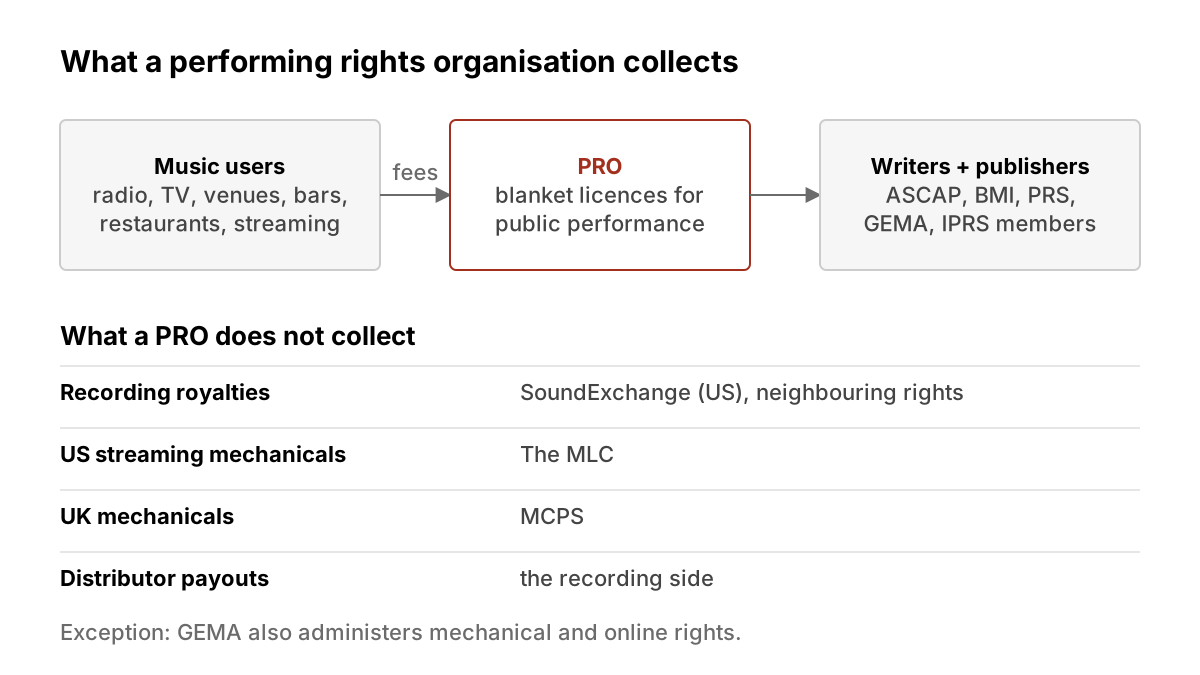
BMI's own BMI 101 summary puts it plainly. Public performance happens "when a composition is performed publicly", which it says includes radio stations, TV networks, venues, sports arenas, restaurants, bars, and interactive and non-interactive streaming services. "This is the only royalty that BMI pays." BMI describes its role as issuing licences to businesses that use music, collecting the fees, and paying them back to writers and publishers.
The model is the same everywhere: the society gathers the rights from its members, sells blanket licences to users, and distributes what it collects. That pooling is also why PROs are regulated. The US Department of Justice describes ASCAP and BMI as organisations that aggregate public performance rights from songwriters and publishers, and both have operated under antitrust consent decrees first entered in 1941.
The societies, country by country
United States: ASCAP and BMI
The US has more than one PRO, and a writer picks one. BMI says it has "an open-door policy, meaning anyone can sign up as an affiliate", and that it represents over 22.4 million works by more than 1.4 million songwriters, composers and publishers. Once you join you get an account number and a public IPI number (the ID that identifies you as a rights holder across societies), and you register each song with your co-writers, their PROs, publishers and the agreed split. BMI pays quarterly.
ASCAP plays the same role. If you are in the US, the choice between them is less important than doing the registration properly once you have chosen.
United Kingdom: PRS, and MCPS next door
PRS for Music says that by joining "you exclusively assign your performing right to PRS", which it defines as the right to perform or communicate the composition to the public. That word "exclusively" matters: it is the society, not you, that licenses those uses from then on.
Writers pay a one-off £100. PRS's help page recommends joining "when you're likely to earn more than £100 in royalties over a year", which is unusually honest advice. If you are under 25 the fee is £30 for lifetime membership, a cut reported by CISAC in 2023.
The UK splits mechanicals off. MCPS, a separate membership with its own fee, "manages the right to copy your work (such as for CDs or digital downloads)", PRS says. You need it only if your music is being reproduced.
Germany: GEMA does more than performance
GEMA is the clearest example that "PRO" does not mean the same thing everywhere. Its membership page lists performing rights, but also mechanical reproduction and distribution rights for carriers, broadcasting, making available online, and ringtones. One society, several rights.
Membership is individual: a band cannot join, but each member who writes can. Pure performers who do not compose or write lyrics cannot join. Membership starts once both sides sign a Deed of Assignment and the fees are paid. GEMA's fee page gives creators a one-off admission fee of €90 plus VAT (€107.10) and €50 a year, and waives the admission fee for anyone aged 30 or under in the year they apply.
India: IPRS
The Indian Performing Right Society represents composers, lyricists and music publishers. It was first registered as a copyright society under Section 33 of the Copyright Act in 1996, according to a law firm summary; the 2012 amendment required every society to re-register, and IPRS was de-registered in June 2013 before being registered again.
The same 2012 amendment is the reason IPRS matters to Indian writers now. In an interim order reported by SpicyIP, the Bombay High Court read the provisos added to Sections 18 and 19 as giving lyricists and composers a right to royalties when a sound recording containing their work is communicated to the public, such as on radio. The order is interim and says itself that it is not a precedent. Our earlier piece on India's radio royalties covers that fight in detail.
How the money crosses borders
You join one society, usually in the country where you live, and it collects for you abroad through agreements with societies in other countries. BMI, for one, says it networks with societies worldwide so writers are paid wherever their music is performed. On our reading, that is why your registration details have to be right at home: money from abroad can only reach you if the song can be matched to you. If you co-write with someone in another country, each of you registers the song with your own society, and the splits need to match.
What a PRO does not collect
This is where most independent writers leave money behind. Your PRO will not collect:
- Recording royalties. A PRO pays for the song, not the master. In the US, SoundExchange says it collects digital performance royalties for the featured artist and the recording owner from non-interactive services such as satellite radio and webcasters, and that it "does not currently collect or distribute royalties for songwriters or publishers". Outside the US, the equivalent is neighbouring rights, which we explain in our guide to neighbouring rights.
- US mechanical royalties from streaming. The Copyright Office designates the Mechanical Licensing Collective to "collect and distribute mechanical royalty payments" under the blanket licence for downloads and interactive streams. A stream can earn both a performance royalty (through your PRO) and a mechanical one (through the MLC). See mechanical royalties and the MLC.
- UK mechanicals, unless you also join MCPS.
- Your distributor's payouts. The money your distributor pays you is the recording side. It is not the same money as your PRO statement and does not replace it.
GEMA is the exception that proves the rule: because it also administers mechanical and online rights, a German writer gets more under one roof. Do not assume your society works that way; read its list of rights.
What we think
PROs are old, slow and often opaque, and they are still the single best value admin step a songwriter can take. The fees are small next to what a song played on radio or in public can earn over years, and in the US joining BMI costs nothing, by its own account of an open-door policy.
Where we are less charitable is the gap between "join a PRO" advice and reality. Most of the internet still says it as if one sign-up covers your songs. It does not. A PRO covers public performance of the composition, and depending on where you live, mechanicals, recording royalties and neighbouring rights each need their own registration. The societies themselves could make this far clearer at sign-up: a single line listing what this membership does not collect would save writers years of unclaimed money. PRS telling you not to join until you will probably earn £100 a year is the kind of plain advice we would like to see everywhere.
Our take for artists who write their own songs: join your home society once you are releasing and getting played, register every song with correct splits the week it is released, and then go through the "does not collect" list above, one item at a time.
Checklist
- Pick one society in your home country and check its fee and eligibility rules on its own site.
- Note your IPI number once you have joined.
- Register every song with all co-writers, their societies and the agreed splits.
- Check whether your society also covers mechanicals; if not, sort them separately (MCPS in the UK, the MLC for US streaming).
- Register your recordings separately for recording-side royalties.
Sources
- BMI 101, BMI (primary source). Accessed 24 Oct 2026.
- ASCAP and BMI Consent Decree Review, US Department of Justice, Antitrust Division (primary source). Accessed 24 Oct 2026.
- Frequently Asked Questions, SoundExchange (primary source). Accessed 24 Oct 2026.
- Orrin G. Hatch–Bob Goodlatte Music Modernization Act, US Copyright Office (primary source). Accessed 24 Oct 2026.
- Join PRS for Music, PRS for Music (primary source). Accessed 24 Oct 2026.
- How much does it cost to join?, PRS for Music (primary source). Accessed 24 Oct 2026.
- Become a member, GEMA (primary source). Accessed 24 Oct 2026.
- Membership fee, GEMA (primary source). Accessed 24 Oct 2026.
- PRS for Music reduces joining rate to £30 for music creators under 25s, CISAC. Accessed 24 Oct 2026.
- India: Re-registration of IPRS as a copyright society, S.S. Rana & Co.. Accessed 24 Oct 2026.
- Music to many ears: Bombay High Court recognises the right to receive royalties by authors of underlying works, SpicyIP. Accessed 24 Oct 2026.
Researched with AI assistance, written and checked by WATMM Desk.