Learn — By WATMM Desk —
Neighbouring rights explained: what performers and master owners can collect, and from whom
Neighbouring rights pay the people behind a recording, not the song: the master owner and the performers on it. This guide sets out the two roles, how PPL in the UK and SoundExchange in the US split the money, where the US differs, and what a self-releasing artist should register, using PPL, SoundExchange, WIPO and US statute pages read on 24 Oct 2026.
Key facts
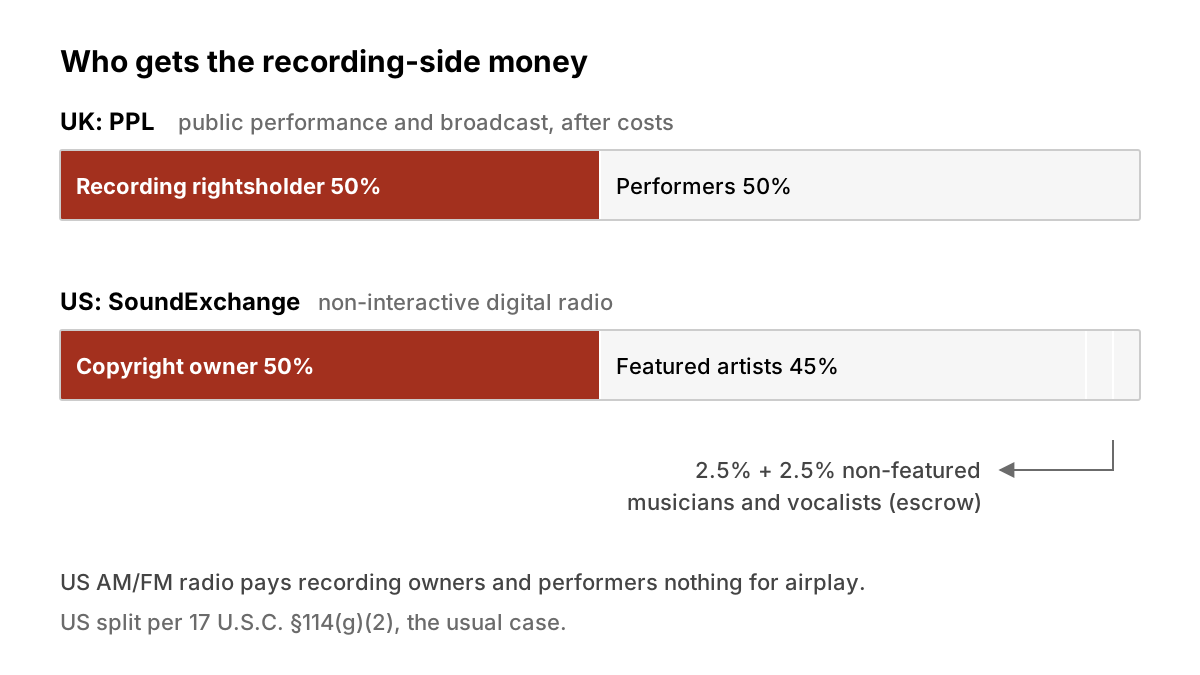
- PPL allocates one half of licence money for a recording to the recording rightsholder member and the other half to qualifying performers, after costs.
- For most recordings, US law splits SoundExchange receipts 50% to the copyright owner, 45% to featured artists and 2.5% each to escrow accounts for non-featured musicians and vocalists (17 U.S.C. §114(g)(2)).
- SoundExchange says there is no US performance right for over-the-air broadcasts, and that registering with it is free.
- The Rome Convention lets member states choose not to apply, or to limit, its rule on equitable remuneration for broadcast recordings.
Every released track carries two copyrights: one in the song (the composition) and one in the recording (the master). Publishing royalties, collected by performing rights organisations and mechanical collectors, pay the songwriters. Neighbouring rights, sometimes called related rights, pay the people behind the recording instead: whoever owns the master, and the performers who played or sang on it.
This guide is about that second stream. It is general information, not legal advice, and it describes the rules as the sources below state them on 24 Oct 2026. We deliberately cover only two systems in detail, the UK's PPL and the US's SoundExchange, because their own pages are clear. Rules elsewhere vary and change, so check your local society directly rather than assuming either model applies.
If you want the songwriter side first, read our guide to performing rights organisations. For how streaming payouts are worked out, see how streaming royalties are calculated.
Two roles, two claims
The key idea is that one person can hold two separate claims on the same recording.
- The master owner (also called the recording rightsholder or sound recording copyright owner) is usually the label. If you release your own music and paid for the recording, that may be you.
- The performers are the people whose performances are on the recording. Collecting societies often treat featured artists and session players differently.
A self-releasing artist who owns their masters and also performs on them may be owed money in both roles. Registering in one role does not automatically register you in the other, so it is worth checking each.
The UK: PPL and the 50/50 split
PPL licenses recorded music played in public or broadcast in the UK. According to PPL's explainer on how royalties are calculated, after costs, "one half of the money is allocated to the relevant recording rightsholder member" and "the other half is allocated to the performers who qualify to receive royalties."
PPL says it receives reports of music played by broadcasters, music suppliers and businesses, matches them against its repertoire database, and pays each recording based on how often it was played. The amount also depends on factors such as the station, the amount of airplay and audience size. Where a recording has more than one performer, PPL splits the performer half either by a performer share agreement or by its own allocation policy. The practical upshot: if your recordings and line-up are not in its database correctly, the matching step has nothing to match.
The US: SoundExchange and digital radio
The US works differently. SoundExchange's FAQ says it "collects and distributes royalties for the featured artist and the sound recording copyright owner" for non-interactive digital radio, from services such as satellite radio, webcasters and digital cable music providers. It also says plainly that "there is no performance right for over-the-air broadcasts." AM/FM radio in the US does not pay recording owners or performers for airplay.
The split for these digital transmissions is set in statute. Under 17 U.S.C. §114(g)(2), 50% goes to the copyright owner, 45% to featured artists, and 2.5% each into escrow accounts for non-featured musicians and non-featured vocalists, administered independently. The statute also provides a separate deduction from the featured share for certain recordings made before 1 November 1995, so treat 50/45/2.5/2.5 as the usual case rather than every case.
SoundExchange's FAQ says it does not pay non-featured artists such as session musicians and backing singers directly; it points them to bodies such as the American Federation of Musicians. It also says that registering is free, and that a collaboration with a featured guest is treated as 50/50 unless the collaborators direct otherwise.
Why countries differ
The international baseline is the 1961 Rome Convention. WIPO's summary says that when a recording is broadcast, "a single equitable remuneration must be paid by the user to the performers, to the producers of the phonograms, or to both", but that member states are "free, however, not to apply this rule or to limit its application." That flexibility is one reason the UK and US models above look so different, and why you should not assume what any other country pays without checking its society's own rules.
A short checklist
- Work out which roles you hold on each release: master owner, featured performer, session performer, or several.
- Get your identifiers right. Societies match plays to recordings, so the ISRC and performer credits on each track matter. Our guide to ISRC, ISWC and split sheets covers this.
- Register with the society where you live, in each role it offers, and ask it directly how it handles plays abroad.
- If your music is on US digital radio, look at SoundExchange as well. Its FAQ says registration is free.
- Agree splits in writing with collaborators, since both PPL and SoundExchange refer to agreements between performers when dividing shares.
What we think
Neighbouring rights are the least glamorous royalty stream, and that is exactly why they get missed. Songwriters hear about PROs early; performers and self-releasing master owners often do not hear that this second claim exists at all. The two systems we looked at make the same point in different ways: the money follows registered data, not the music itself. PPL pays on matched plays; SoundExchange pays the parties it has on file.
Our view is that any artist who owns their masters should treat neighbouring-rights registration as part of releasing a record, not an optional extra for later. It is mostly admin. What it is worth will vary hugely with where your music is played and on what, and we would be wary of anyone promising a figure in advance. The honest pitch is narrower: if the plays happen and you are not registered, you are relying on someone else to have filled in your details correctly.
For a longer, news-led look at PPL and the gap for US performers abroad, see our neighbouring rights explainer for indie artists.
Sources
- How royalties are calculated, PPL (primary source). Accessed 24 Oct 2026.
- Frequently Asked Questions, SoundExchange (primary source). Accessed 24 Oct 2026.
- 17 U.S. Code § 114, Legal Information Institute, Cornell Law School (primary source). Accessed 24 Oct 2026.
- Summary of the Rome Convention (1961), WIPO (primary source). Accessed 24 Oct 2026.
Researched with AI assistance, written and checked by WATMM Desk.