Learn — By WATMM Desk —
ISRC, ISWC and split sheets: who issues each one, and the order to get them in
Two codes and one document hold your royalties together. An ISRC names the recording and comes from the recording owner, a national agency or a manager such as your distributor. An ISWC names the song and only a registration agency, usually your collecting society, can assign it. A split sheet has no issuer at all: you and your co-writers make it. Here is who issues what, what it costs where we could check, and why the split sheet has to come first.
Key facts
- ISRC: assigned by the owner of the recording, through the ISRC agency for your territory, an appointed ISRC Manager such as a distributor, or the international online service for self-releasing artists. The US agency charges a one-time $95 fee for a rights owner prefix.
- ISWC: assigned only by local or regional registration agencies, during registration of the work and only once every creator is uniquely identified. Creators cannot assign their own.
- Split sheet: no body issues one. US law makes the authors of a joint work co-owners, and The MLC runs a dedicated tool for songs whose claimed shares exceed 100 percent.
Most explainers of music metadata start with the codes. This one starts with who hands each one out, because that is where self-releasing artists get stuck: you can't ask the right body for something if you don't know which body it is. If you want the full tour of all four codes, including IPI and UPC, read our ISRC, ISWC, IPI and UPC explainer. Here we narrow it to the two codes and one document that every co-written release needs, and the order to get them in.
This is a practical guide, not legal advice, and everything below is as we read the sources on 24 Oct 2026.
The short version
| Names | Who issues it | Can you do it yourself? | |
|---|---|---|---|
| ISRC | A sound recording or music video | The recording's owner, via a national agency, an ISRC Manager or the international online service | Yes, if you own the recording |
| ISWC | A song (the musical work) | A registration agency, usually your collecting society | No |
| Split sheet | Who wrote what share of the song | Nobody: you and your co-writers | Yes, and you have to |
ISRC: the recording, and you can issue it
The International Standard Recording Code identifies sound recordings and music videos, not songs, products or performers. The unusual thing about it is that the issuer is you. The international authority says ISRCs are assigned by owners of recordings, and its FAQ says membership of an industry body isn't required: "any entity creating sound or music video recordings can assign ISRCs to their recordings." Only the rights owner, or an ISRC Manager appointed to act for them, may assign one.
There are three routes:
- Your national ISRC agency. The FAQ's first instruction is to "contact the ISRC Agency for your territory". In the US that is the agency at usisrc.org, run by the RIAA, which charges a one-time $95 administrative fee for a rights owner prefix. You then assign the codes from that prefix yourself.
- An ISRC Manager. Distributors and other providers can be appointed to assign codes for you. The catch, in the FAQ's own words: "the music distributor may or may not enter the data into the International ISRC Database."
- The international online service. If your territory has no agency, or you are a self-releasing artist, the authority offers online assignment. The FAQ prices it at 3 credits per new code. We could not find the price of a credit on the pages we opened.
Two rules to keep. Once assigned, an ISRC "must not be re-used under any circumstances", and it "should remain the same for the lifespan of the track", even if the track changes owner. A remaster usually keeps its code unless it involves significant new creative input.
ISWC: the song, and you can't issue it
The International Standard Musical Work Code identifies the musical work itself, separate from any recording of it. It looks like T-034.524.680-1: a T, nine digits and a check digit. CISAC administers it and, since a 2020 modernisation, all ISWCs are assigned centrally, with local agencies handling the paperwork.
Unlike an ISRC, you can't make one. The ISWC agency says registration agencies are responsible for assigning ISWCs, and creators and publishers cannot assign their own. For a new song "no steps are necessary": the code is assigned when the work is registered, normally by your collecting society or your publisher. Older works can be given one at any time. The agency's page mentions no fee.
The condition that matters most is this one: an ISWC is allocated only "when all of the creators of the work have been uniquely identified." So the code for your song depends on every co-writer being properly identified at registration. That is why the split sheet comes first.
Split sheets: the document nobody issues
A split sheet is a short agreement between the writers of a song saying who wrote it and what share each owns. No agency, society or standards body issues it. There is no official form we could find from a primary source. You make it, ideally in the session.
The law gives it its weight. Under US copyright law, copyright vests in the author or authors, and "the authors of a joint work are coowners of copyright in the work." Co-owners who never wrote down their shares have only memory to go on when they register.
And registrations do disagree. In the US, The MLC runs an Overclaims Tool for exactly the case where the ownership shares submitted for one song add up to more than 100 percent. Its Matching Tool exists to connect recordings (ISRCs) to songs. Both tools fix problems that a signed split sheet, shared with everyone who registers anything, would have prevented.
A workable split sheet carries, at minimum:
- the song title, and any working titles;
- the date and where it was written;
- each writer's legal name, as it appears at their society;
- each writer's society and IPI number, if they have one;
- each writer's publisher, if any;
- each writer's share, totalling 100%;
- every writer's signature, with a copy for each.
Keep producer points on the master separate. Those are a share of the recording, not the song, and they belong in a producer agreement.
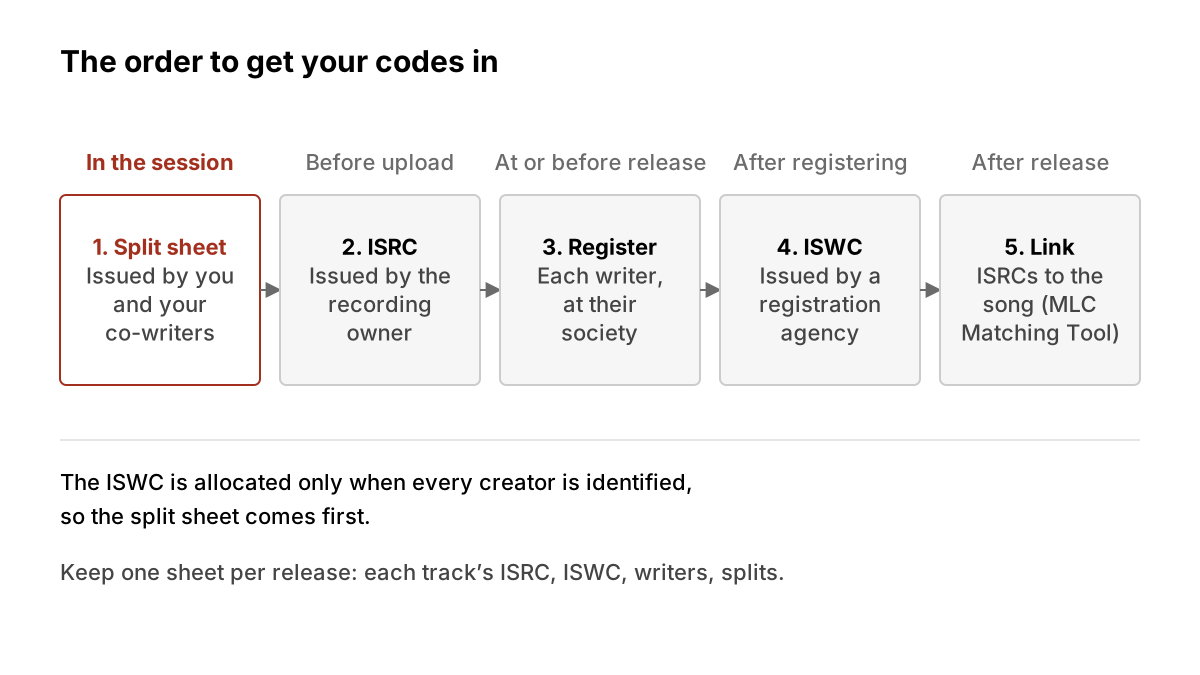
The order that works
- In the session: the split sheet. Agree shares while everyone is in the room, sign it and send everyone a copy. If someone isn't with a society yet, note that; it will hold up the ISWC.
- Before upload: the ISRC. Decide whether you assign it from your own prefix or let your distributor do it. Write the code against each mix and edit. A different edit or a remix is a new recording and needs its own code.
- At or before release: register the work. Each writer registers the song with their society at the shares on the split sheet, using the same title spelling. The society's registration is what leads to an ISWC.
- After release: link them. In the US, check The MLC's Matching Tool for your ISRCs and link any that weren't matched to your song.
- Keep one sheet per release listing each track's ISRC, ISWC, writers and splits.
What we think
The three things in this guide are issued by three different kinds of authority: you (ISRC), a society (ISWC) and, for the split sheet, nobody. That last gap is the one that costs artists money, because it is the only one with no institution chasing it. A distributor will block your upload without an ISRC. Nobody blocks a release for a missing split sheet. You just find out months later when a registration stalls.
So we'd treat the split sheet as the first deliverable of a co-write, not paperwork for later. It costs nothing, takes ten minutes, and it is the input every later step depends on: the ISWC waits for identified creators, and The MLC's overclaims tool exists because shares were registered from memory.
We'd also own your ISRCs where you can. A distributor-issued code is convenient, but by the authority's own account it may never reach the international database, and an artist who controls their own prefix doesn't have to ask anyone for their recording's identity when they change distributor. In the US that is a one-time $95.
Sources
- ISRC FAQs, International ISRC Registration Authority
- Get an ISRC, International ISRC Registration Authority
- International Standard Recording Code, International ISRC Registration Authority
- US ISRC Agency, RIAA
- Get an ISWC and What is the ISWC?, CISAC
- 17 U.S. Code § 201, Legal Information Institute
- Member Tools, The MLC
Sources
- ISRC FAQs, International ISRC Registration Authority (IFPI) (primary source). Accessed 24 Oct 2026.
- Get an ISRC, International ISRC Registration Authority (IFPI) (primary source). Accessed 24 Oct 2026.
- International Standard Recording Code, International ISRC Registration Authority (IFPI) (primary source). Accessed 24 Oct 2026.
- US ISRC Agency, Recording Industry Association of America (primary source). Accessed 24 Oct 2026.
- Get an ISWC, CISAC (ISWC International Agency) (primary source). Accessed 24 Oct 2026.
- What is the ISWC?, CISAC (ISWC International Agency) (primary source). Accessed 24 Oct 2026.
- 17 U.S. Code § 201 - Ownership of copyright, Legal Information Institute, Cornell Law School (primary source). Accessed 24 Oct 2026.
- Member Tools, The MLC (primary source). Accessed 24 Oct 2026.
Researched with AI assistance, written and checked by WATMM Desk.