Learn — By WATMM Desk —
How streaming royalties are calculated: pro-rata pools, the 1,000-stream threshold and artist-centric models
There is no per-stream rate. Streaming services pool their net revenue each month and split it by share of streams, and two newer rules change who gets into that split: Spotify ignores tracks under 1,000 streams a year, and Deezer weights streams from established artists and active fans. Here is the whole chain, step by step, as the services describe it on 24 Oct 2026.
Key facts
- Spotify says it does not pay per stream. It pools net revenue from Premium and ads and splits it by each rightsholder's share of the month's streams.
- Since 1 Apr 2024 a Spotify track needs at least 1,000 streams in the previous 12 months, plus an unpublished minimum of unique listeners, to count in the recorded-music royalty pool.
- Deezer's artist-centric model counts a stream twice for artists with more than 1,000 listens a month from at least 500 unique listeners, and again when a fan actively searched for the track; boosts can stack to four times.
Every streaming payout starts with the same misunderstanding: that a service pays a fixed amount per play. Spotify says plainly that it "does not pay artist royalties according to a per-play or per-stream rate" (Spotify for Artists). What it runs is a monthly pool, split by share. Two newer rules, Spotify's 1,000-stream threshold and Deezer's artist-centric model, change who gets into that pool and how much a stream weighs.
This guide walks the chain from a listener's subscription to your statement. We go deep on the per-stream maths in streamshare explained with real numbers and on Deezer's results in how Deezer's artist-centric model moves the money. This piece is the map that connects them. Everything below is as we read the services' own pages on 24 Oct 2026.
Step 1: the pool
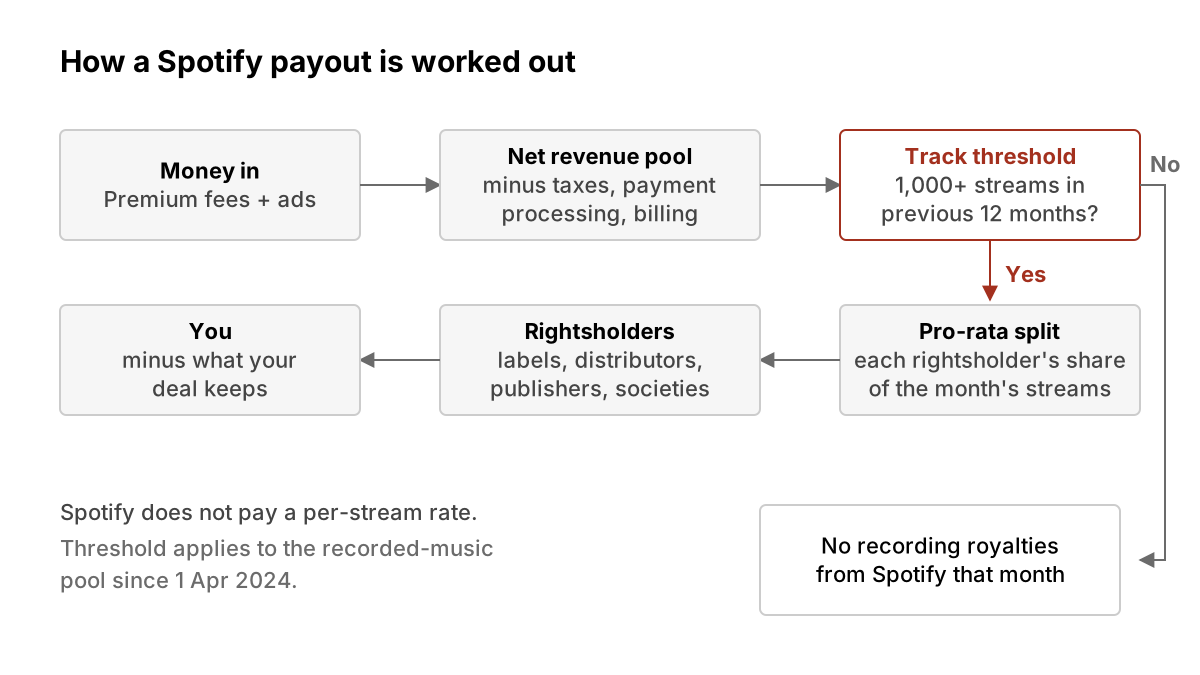
Each month a service collects money from subscriptions and ads. Spotify says it distributes "the net revenue from Premium subscription fees and ads to rightsholders", and that to get net revenue it subtracts "the money we collect but don't get to keep", such as taxes and payment processing and billing costs (Spotify for Artists).
Of what is generated from music, Spotify says it pays "roughly two-thirds of every dollar" to the rightsholders of artists and songwriters (Loud & Clear). It reports paying out more than $11 billion in 2025. That pool covers both recordings and compositions, which reach you by different routes (step 4).
Spotify also notes that payments vary with how music is streamed and with each artist's label or distributor agreement.
Step 2: the pro-rata split
This is the "pro-rata" or "market-centric" model, and it is how most of the industry still works. Spotify tallies "the total number of streams in a given month" and works out what share of them played music each rightsholder owns or controls. That streamshare decides the rightsholder's share of net revenue (Spotify for Artists).
The thing artists need to grasp is that your income depends on everyone else's streams too. If total listening rises faster than yours, your share falls even when your own count goes up. And your subscriber's fee does not follow their listening: under pro-rata, what any one fan pays goes into the shared pool, not to the artists that fan played.
Step 3: the filters before the split
Pro-rata used to count every eligible play. Since 1 Apr 2024 Spotify has applied new rules first (Spotify for Artists blog).
The 1,000-stream threshold. A track must have reached "at least 1,000 streams in the previous 12 months" to be included in the recorded-music royalty pool. It also needs "a minimum number of unique listeners", which Spotify does not publish "to prevent further manipulation" (track monetization eligibility). Eligibility is checked every month, so a track can move in and out. Tracks below the line are left out of the streamshare calculation and earn no recording royalties from Spotify for that month.
Spotify's reasoning, from its announcement: tracks under the threshold averaged "$0.03 per month", and these small payments, often never withdrawn because distributors have minimum payout levels, "added up to $40 million per year". Spotify says that money now goes to tracks above the line. Spotify projected the three changes together would move about an extra $1 billion toward emerging and professional artists over five years.
Note the scope. The threshold applies to the recorded-music pool on Spotify. Spotify's help page says the threshold does not change how publishing royalties are calculated "for now" (track monetization eligibility).
Noise. Functional noise recordings, such as white noise, must now be at least two minutes long to earn, and are valued "at a fraction of the value of music streams" (Spotify for Artists blog).
Artificial streaming. Spotify now charges labels and distributors per track when it detects "flagrant artificial streaming". What that means for your distributor account is in our piece on the penalty fee.
Step 4: from the service to you
No service pays you directly. Spotify says it pays the rightsholders artists and songwriters choose, such as labels, distributors, publishers and collecting societies, and they pay out under their own agreements (Loud & Clear). Deezer says the same: it pays distributors, who pay artists (Deezer).
So the number you see is the service's share for your tracks, minus whatever your label or distributor keeps under your deal. The songwriting side travels separately through publishers and collecting societies. Our line-by-line royalty statement walkthrough shows where each piece lands.
The alternative: artist-centric weighting
Deezer kept a pool but changed how streams count. Its page sets out the rules (Deezer):
- Artist boost. "Any artist with more than 1000 listens per month, by at least 500 unique listeners, receives a boost (one stream = two)."
- Engagement boost. Streams also count more when fans actively search for a song, or discover it on Deezer's own playlists rather than through algorithmic suggestions.
- Stacking. The boosts combine, making a stream worth up to four times a non-boosted one.
- A per-user cap. Each user counts for at most 1,000 streams a month, which Deezer says limits fraud.
- Noise. Deezer removes non-artist noise such as rain and white noise and replaces it with its own content that earns no royalties.
The idea is the same as Spotify's: move money away from low-engagement and possibly fraudulent streams and towards artists whose fans choose them. The method differs. Spotify sets a floor for each track, while Deezer adds weight on top of the stream count.
What changes for you in practice
| If you are... | Spotify (pro-rata with threshold) | Deezer (artist-centric) |
|---|---|---|
| An artist with a large back catalogue of small tracks | Tracks under 1,000 streams a year earn nothing on the recording side | Low-traffic tracks still count, but at the unboosted weight |
| An artist under 1,000 listens a month | Each track over the threshold is paid at the normal share | Your streams count once, while bigger artists' count at least twice |
| An artist with fans who search for you by name | No extra weight for searches | Searched streams can be boosted |
| Making noise or ambient filler | Two-minute minimum and a reduced value | Replaced and not paid |
What we think
Both models say they are about fairness, and both are partly right. Clearing out fractions of a cent and fake streams is worth doing, and a fan's deliberate search is a better signal than a stream from autoplay.
But look at who carries the cost. Under both systems the newest, smallest artists pay first: a track below 1,000 streams on Spotify drops out, and an artist below 500 monthly listeners on Deezer is paid at half the weight of a boosted one. The money does not leave the pool; it moves upward. Spotify's own figure is that the money in question averaged three cents a month per track, so for any single artist the loss is small. Across a long catalogue of quiet releases it is not nothing, and the line itself is invisible in part, since Spotify keeps the unique-listener minimum secret.
Neither model fixes the deeper issue of pro-rata: your fan's subscription still does not follow your fan's listening. A user-centric model, where each subscriber's money is split only among the artists they played, would. Neither of the two services in this guide uses it.
For artists, the practical advice is simple. Release fewer, stronger tracks rather than flooding a catalogue. Check which of your tracks sit near 1,000 streams a year and push those, not the ones that will never get there. Build fans who look you up by name, because on at least one service that now pays more. And read your distributor's terms on payout minimums and artificial streaming charges, since that is where the service's maths meets your bank account.
Sources
- Understanding Spotify royalties, Spotify for Artists (primary source). Accessed 24 Oct 2026.
- Loud & Clear FAQ, Spotify (primary source). Accessed 24 Oct 2026.
- Track monetization eligibility, Spotify for Artists (primary source). Accessed 24 Oct 2026.
- Modernizing Our Royalty System to Drive an Additional $1 Billion toward Emerging and Professional Artists, Spotify for Artists (primary source). Accessed 24 Oct 2026.
- Artist remuneration, Deezer (primary source). Accessed 24 Oct 2026.
Researched with AI assistance, written and checked by WATMM Desk.