Learn — By WATMM Desk —
Choosing headphones for music production: open, closed, impedance and what actually matters
A practical guide to picking studio headphones: why you may need two pairs, what open and closed backs are each good at, how to read impedance labels against the interface you own, and what to check before you buy. Manufacturer details are from beyerdynamic and Sonarworks, read on 25 Oct 2026.
Key facts
- beyerdynamic sells the closed DT 770 PRO in 32, 80 and 250 ohm versions, labelled "Mobile Devices", "Universal Studio" and "Professional Devices".
- beyerdynamic says that "for mixing and mastering in the studio, open headphones are often used because of the better spatial representation."
- Sonarworks says SoundID Reference supports over 500 headphone models by applying a pre-made calibration profile.
Most people who make music at home do most of their listening on headphones. That makes the headphones you choose one of the most important decisions in a home studio, and one of the easiest to get wrong, because the pair that sounds most exciting in a shop is often the worst pair to make decisions on.
This guide is for beginners and intermediate producers choosing their first or second serious pair. It does not rank models. It explains what the specifications mean for the work you do, so you can judge any pair yourself. Manufacturer details were read on 25 Oct 2026.
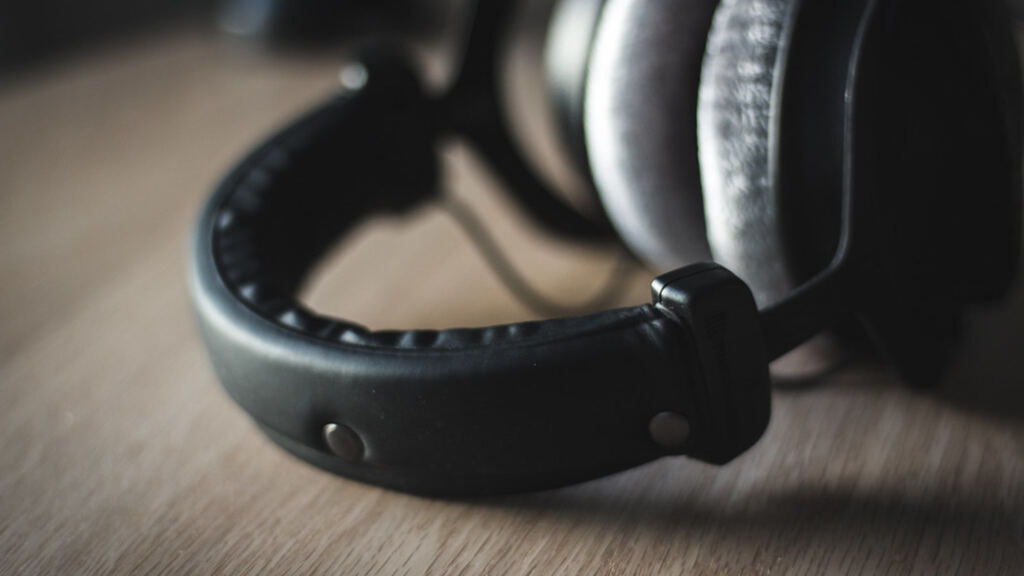
Start with the job, not the brand
Headphones in a studio do two different jobs, and they pull in opposite directions.
Tracking means recording: a singer or player wears headphones to hear the backing track while a microphone is open nearby. Here the priority is isolation. Sound must not leak out of the headphones into the mic, and the performer should hear themselves clearly over the room.
Mixing and editing means making judgements about balance, tone and space. Here the priority is a natural, even presentation that you can listen to for hours without fatigue.
If you only make music in the box, with no microphones, you can choose purely for the second job. If you record vocals or acoustic instruments, you either buy one pair that compromises or, as many producers eventually do, two pairs.
Open back or closed back
The ear cup design is the biggest single choice.
Closed-back headphones have sealed cups. They isolate better in both directions: less outside noise gets in and less of your track spills out. That is what you want when recording, and when working in a shared room or at night. The trade-off is that sealed cups can build up pressure and resonance, which tends to colour the bass, and they can feel warm on long sessions. beyerdynamic's DT 770 PRO is a common example; its spec sheet lists the operating principle simply as "Closed".
Open-back headphones have vented cups that let sound pass through. They leak, so they are poor for recording next to a microphone and antisocial on a train, but they generally present a wider, more speaker-like image. beyerdynamic's own product FAQ for the DT 990 PRO says that "for mixing and mastering in the studio, open headphones are often used because of the better spatial representation."
A simple rule: if you have one pair and record with a microphone, buy closed. If you never record, or already own a closed pair, an open pair is the better mixing tool.
Impedance, explained without the physics
Impedance, measured in ohms, tells you roughly how much the headphones resist the signal driving them. In practice it answers one question: will your interface or laptop drive these loudly and cleanly enough?
Lower-impedance headphones are easy to drive from phones, laptops and small interfaces. Higher-impedance headphones usually need a stronger headphone amplifier to reach a comfortable level without the output straining. Some manufacturers sell the same model in several versions for exactly this reason. beyerdynamic offers the DT 770 PRO in 32, 80 and 250 ohm versions and labels them "Mobile Devices", "Universal Studio" and "Professional Devices" respectively.
So check what will drive them. If your only output is a compact two-channel interface or a laptop jack, the lower-impedance version of a model is the safer pick. If you have a dedicated headphone amp, or an interface known for a strong headphone output, higher impedance is fine. Our guide to choosing an audio interface covers what to look for in the headphone output itself.
One caution: impedance is not a quality score. A 250 ohm pair is not better than an 80 ohm pair of the same model; it is built for different equipment.
Frequency response and the "flat" myth
Spec sheets quote a frequency range, such as the "5 - 35.000 Hz" beyerdynamic lists for the DT 770 PRO. That number tells you almost nothing useful. Every serious pair covers the range people can hear; what matters is how evenly it covers it, and that the spec range does not show.
No headphone is perfectly flat, and different makers aim for different target curves. What you need is not perfection but familiarity: a pair whose quirks you learn so well that you can mix around them. That is why consistency matters more than the pair itself. Mix on the same headphones for months, check against reference tracks, and your ears will calibrate.
Correction software can help. Sonarworks says its SoundID Reference supports over 500 headphone models and that for headphones you "simply apply a pre-made calibration profile available in the software." Two things follow from that. First, if you plan to use correction, check your model is on the supported list before you buy. Second, a pre-made profile corrects for the model in general, not your individual pair, so treat it as a strong nudge rather than a guarantee. We cover correction and crossfeed in more depth in mixing on headphones.
Comfort, cables and repairs
The practical details decide whether you keep using a pair.
- Clamping force and weight. Production sessions run for hours. Pressure that is fine for twenty minutes can become a headache by the second hour. Try before you buy if you can, ideally for a long stretch.
- Pads. Velour pads tend to breathe better on long sessions; leatherette tends to seal better for isolation. beyerdynamic lists leatherette pads on the 32 ohm DT 770 PRO and velour on the others, a small sign of how pads follow the intended use.
- Replaceable parts. Pads wear out and cables fail. A pair whose pads and cable you can buy and swap will outlast a cheaper sealed design.
- Cable type. A coiled cable suits a desk; a straight cable is lighter. A detachable cable is easier to replace.
What to skip
Avoid consumer headphones tuned for excitement: heavy bass boosts and bright treble make every mix sound finished, which is exactly the problem. Skip Bluetooth for production work, because wireless links add delay that makes recording in time difficult; our latency guide explains why even small delays matter. And avoid active noise cancellation while mixing, since it changes what you hear.
A short buying checklist
- Decide the job: tracking, mixing, or both.
- Closed back if you record near a microphone; open back if you only mix.
- Match impedance to what will drive them.
- Check pads and cables are replaceable.
- If you use correction software, confirm your model is supported.
- Commit to one pair and learn it with reference tracks.
What we think
The most common advice, "buy the flattest headphones you can afford", points beginners at the wrong problem. The quality ceiling of a decent studio pair is far above most home mixes; the real limit is that the producer has not lived with any one pair long enough to know it. We would rather someone mixed for a year on one modest, comfortable closed pair than switched between three expensive ones in the same year.
So spend your effort on fit for your job and on staying power: comfort, repairable parts, and an impedance that suits your interface. If you later add a second pair, make it the opposite design to the first, open if you started closed, and use the gap between them as a check. The headphones that improve your mixes are the ones you know, not the ones with the best review.
Sources
- DT 770 PRO, beyerdynamic (primary source). Accessed 25 Oct 2026.
- DT 990 PRO, beyerdynamic (primary source). Accessed 25 Oct 2026.
- SoundID Reference, Sonarworks (primary source). Accessed 25 Oct 2026.
Researched with AI assistance, written and checked by WATMM Desk.