Learn — By WATMM Desk —
Training-data licensing explained: who gets paid when AI learns from music
So far, every deal that pays for training AI on music runs through an intermediary (a label, publisher, distributor, collecting society or sample marketplace), and almost none publishes a rate. Here is how the four deal structures work, what the law says in the EU, UK, US and India as of 23 Oct 2026, and what an independent artist can actually claim.
Key facts
- Deals so far: label settlements with licences (UMG and Udio, Oct 2025; Warner and Suno, Nov 2025), opt-in publisher and distributor schemes (Kobalt and Merlin with ElevenLabs; TuneCore's AI & Data Protection Program), collective licences (STIM, GEMA) and per-source payment (Splice).
- Published numbers are rare: GEMA asks for 30% of an AI provider's net income plus a minimum royalty; Kobalt's deal reportedly gives publishing about half of the royalties. No label deal has a public rate.
- The law differs by place: an opt-out in the EU, no commercial training exception in the UK, case-by-case fair use in the US, and a proposed licence in India that rightsholders could not refuse.
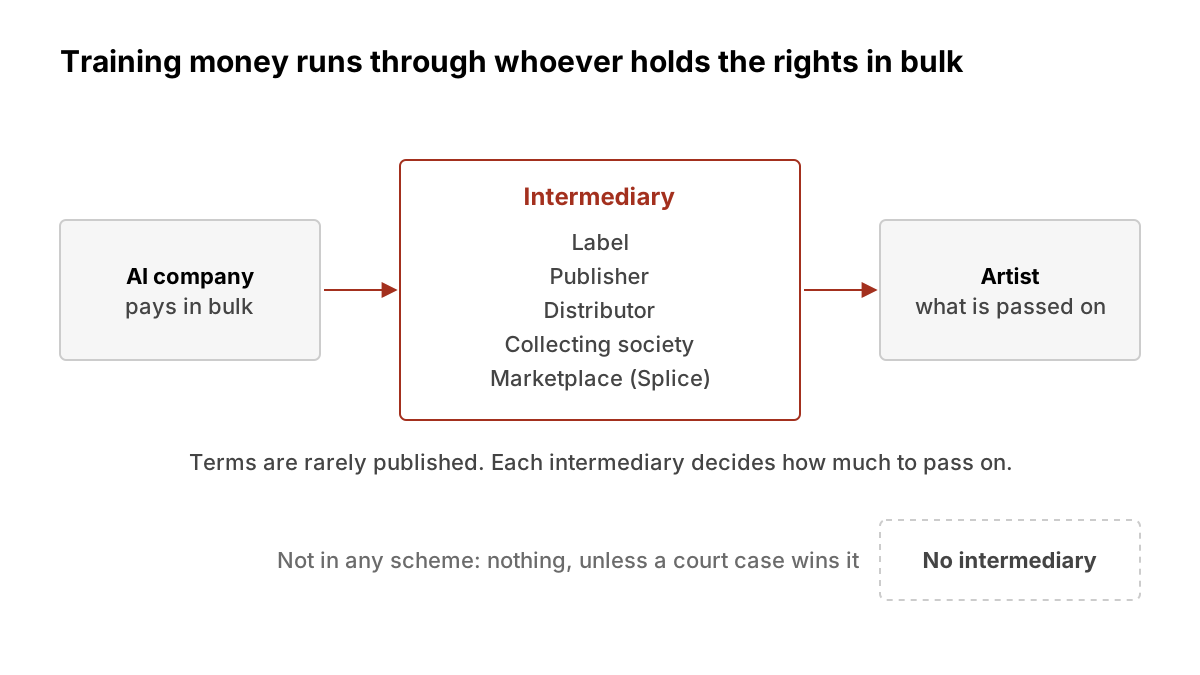
In every training deal we could find, the AI company pays whoever holds the rights in bulk, not the person who wrote or played the music, and the terms are rarely published. This explainer sets out the deal structures that exist, what the law says in four places, and what that means if you're independent.
It isn't legal advice. Training rules are national and still moving; everything below is as we read it on 23 Oct 2026.
The four ways training gets paid for
1. Settle the lawsuit, then license. This is how the big label deals came about. Universal settled its case against Udio in October 2025 with what its announcement calls a "compensatory legal settlement", plus new licences for recorded music and publishing, for a platform "trained on authorized and licensed music". No figures were given. Warner's November 2025 deal with Suno, per Suno, means new models built on licensed music, and Warner artists can opt in to the use of their names, likenesses, voices and compositions. Suno's product chief later told MBW that a share of revenue goes to partners and the rights holders decide how to distribute it. So what reaches an artist depends on their contract with the label, which is why the US musicians' union is suing Universal and Warner for a share for session players.
2. Opt-in deals through a publisher or distributor. ElevenLabs signed Merlin, which MBW describes as an independent music licensing organisation, and the publisher Kobalt in August 2025. The press release speaks only of "opportunities to participate in AI revenue streams". MBW reported that Kobalt's deal is opt-in and splits the platform's royalties roughly 50/50 between publishing and recordings. For self-releasing artists, TuneCore's AI & Data Protection Program offers Udio and ElevenLabs. Joining makes your music eligible for licensed training. You get a 20-day review only for opportunities that could be associated with you, such as remixes or voice features. Opting out instructs the partner to stop "future participation". No rates are published.
3. Collective licences. Collecting societies license their whole repertoire, or a consenting part of it. Sweden's STIM launched a pilot in September 2025 that pays creators at three points: during training, during use of the AI service, and when its output is used. It covers only works whose owners opted in, and requires independent attribution technology to trace outputs to the works that influenced them. Germany's GEMA asks for 30% of all net income from a generative AI model or system, plus a minimum royalty, and a separate share of income from later use of AI-generated music. In its case against Suno, the Munich judgment records that most of the writers and publishers of the songs involved had signed add-on agreements giving GEMA the exclusive right to use them in AI systems. GEMA relied on those, alongside its standard membership contracts, to show it held the rights it was suing over.
4. Pay per source. Splice says a sample's creator is paid each time the sound is used as the source for an AI variation and each time a variation is downloaded, without saying what either is worth. We covered it in our Splice piece.
What the law says, by place
| Where | Default for commercial AI training | What a rightsholder can do |
|---|---|---|
| EU | Allowed unless rights are reserved (the text-and-data-mining opt-out) | Reserve rights; general-purpose AI providers must respect that and publish a training summary under Article 53 of the AI Act |
| UK | The statutory exception, section 29A, covers only non-commercial research | Refuse or license; the government says an opt-out exception is no longer its preferred option |
| US | No specific rule; fair use is decided case by case | Sue, or license where a market exists |
| India | Proposed: a mandatory blanket licence with no right to withhold works | Register works to share in a statutory royalty, if it becomes law |
The EU details, and what you can actually reserve, are in our AI Act guide. The UK position followed a long fight by musicians.
The US is where the money question is being tested. In Bartz v. Anthropic, a books case, Judge Alsup held in June 2025 that training was fair use but sent the pirated library copies to trial. The case then settled for $1.5 billion, approved on 20 Jul 2026 at roughly $3,000 per work, covering past conduct only, per the Authors Guild. The Copyright Office's training report says unlicensed uses "will be disfavored" where licensing markets are available. That's why Reservoir argues that Suno's label deals prove a market exists.
India's DPIIT working paper would set the royalty as a percentage of gross global revenue, collected by a new body (CRCAT), with creators registering works to be paid. The committee has since stalled.
What independent artists actually get
- Signed to a label or publisher with a deal: whatever your contract passes through. No major has published a rate.
- Self-released through a distributor: an opt-in programme, if your distributor runs one, with no published rates. Believe and TuneCore also put participating repertoire into Suno's new models.
- A member of a society with a scheme: a share under STIM's pilot or GEMA's model, if you opted in or assigned the AI rights.
- None of the above: nothing, unless a court case wins it. Independent musicians suing Google over Lyria face the argument that YouTube's terms already licensed training.
The open gaps
- Rates. GEMA's 30% ask and Kobalt's reported split are about the only numbers in public.
- Opting out doesn't untrain. TuneCore's opt-out stops future participation. Nothing we read removes your music from a model already trained.
- Attribution. STIM requires it to pay on outputs. India's paper says no attribution technique is known to work, so it collects a flat share of revenue and lets societies split it by registered works or market standing. Without attribution, money tends to follow catalogue share, which favours big catalogues.
- Performers. Rights owners license; the players on the recordings negotiate separately, if at all.
What we think
The debate is usually framed as opt-in against opt-out. The more important line is who holds the contract. Every route that pays today runs through an intermediary that holds rights in bulk: a label, a publisher, a distributor, a society, or a marketplace like Splice. Each one prices training per catalogue and decides how much to pass on. An independent artist's real leverage is choosing which intermediary carries their rights, and asking it three questions before joining any AI programme: what is the rate or share, does it pay on outputs as well as training, and who measures attribution?
On the evidence so far, collecting societies answer those questions best. STIM and GEMA are the only parties that have published how their models pay. India shows the risk: a collective scheme can turn into a compulsory licence that removes the right to say no. The combination worth pushing for is collective administration with individual consent, which is what STIM's pilot already does at small scale.
Sources
- UMG and Udio announce strategic agreements, Universal Music Group, 30 Oct 2025
- Suno and Warner Music Group partnership, Suno, Nov 2025
- Suno v6 launches in partnership with WMG, BMG and Believe, Music Business Worldwide
- ElevenLabs launches Eleven Music with music industry partners, ElevenLabs press release, Aug 2025
- Eleven Music launches with Kobalt, Merlin deals, Music Business Worldwide, Aug 2025
- Kobalt's AI deal with ElevenLabs guarantees publishing parity, Music Business Worldwide, 5 Aug 2025
- TuneCore AI & Data Protection Program, TuneCore
- STIM launches the world's first AI licence for music, STIM, 8 Sep 2025
- GEMA's two-component AI licensing model, GEMA, 17 Oct 2024
- Judgment, LG München I, 42 O 763/25, 31 Jul 2026
- AI Act, Article 53, European Commission
- CDPA 1988, section 29A, legislation.gov.uk
- Report on Copyright and Artificial Intelligence, UK Government, 18 Mar 2026
- Order on fair use, Bartz v. Anthropic, N.D. Cal., June 2025
- Court grants final approval of Anthropic copyright settlement, Authors Guild
- Copyright and AI, Part 3: Generative AI Training, US Copyright Office, May 2025
- Working Paper on Generative AI and Copyright, Part 1, DPIIT, Dec 2025
Sources
- Universal Music Group and Udio Announce Udio's First Strategic Agreements for New Licensed AI Music Creation Platform, Universal Music Group via PR Newswire (primary source). Accessed 23 Oct 2026.
- Suno and Warner Music Group partnership, Suno (primary source). Accessed 23 Oct 2026.
- ElevenLabs Launches Eleven Music in Collaboration with Music Industry Partners (press release), ElevenLabs via Record of the Day (primary source). Accessed 23 Oct 2026.
- TuneCore AI & Data Protection Program, TuneCore (primary source). Accessed 23 Oct 2026.
- STIM Launches the World's First AI License for Music, STIM (primary source). Accessed 23 Oct 2026.
- Two components, one goal: Music creators shall receive fair shares through effective AI licensing, GEMA (primary source). Accessed 23 Oct 2026.
- Judgment, Landgericht München I, 42 O 763/25 (GEMA v Suno), Landgericht München I (via KPW) (primary source). Accessed 23 Oct 2026.
- AI Act, Article 53: Obligations for providers of general-purpose AI models, European Commission AI Act Service Desk (primary source). Accessed 23 Oct 2026.
- Copyright, Designs and Patents Act 1988, section 29A, legislation.gov.uk (primary source). Accessed 23 Oct 2026.
- Report on Copyright and Artificial Intelligence, UK Government (primary source). Accessed 23 Oct 2026.
- Order on Fair Use, Bartz v. Anthropic (N.D. Cal. 3:24-cv-05417), US District Court, Northern District of California (via CourtListener) (primary source). Accessed 23 Oct 2026.
- Copyright and Artificial Intelligence, Part 3: Generative AI Training (pre-publication version), US Copyright Office (primary source). Accessed 23 Oct 2026.
- Working Paper on Generative AI and Copyright, Part 1: One Nation One License One Payment, DPIIT, Government of India (primary source). Accessed 23 Oct 2026.
- Suno v6 AI music models launch in partnership with WMG, BMG and Believe, Music Business Worldwide. Accessed 23 Oct 2026.
- Eleven Music, new AI rival to Suno, launches with Kobalt, Merlin deals, Music Business Worldwide. Accessed 23 Oct 2026.
- Kobalt's AI deal with Suno rival ElevenLabs guarantees publishing 'parity' with recorded music, Music Business Worldwide. Accessed 23 Oct 2026.
- Court Grants Final Approval of Anthropic Copyright Settlement, Authors Guild. Accessed 23 Oct 2026.
Researched with AI assistance, written and checked by WATMM Desk.