Learn — By WATMM Desk —
C2PA Content Credentials for audio: what they record, who reads them, and where they fall short
Content Credentials are signed provenance records, built on the open C2PA standard, that can travel inside WAV, MP3, FLAC and M4A files. Here is what a credential actually records, how to check one, which tools read them today, and the limits every artist should understand before relying on one.
Key facts
- What it is: a C2PA manifest is a signed bundle of statements (assertions) about a file, such as how it was made, what was done to it and what it was built from (ingredients).
- Audio support: the C2PA 2.2 specification describes embedding manifests in WAV and BWF, MP3 and FLAC (via ID3) and MP4-family files, and the open-source C2PA Rust SDK lists wav, mp3, flac and m4a.
- The core limit: C2PA's own explainer says provenance information alone "cannot tell you whether the digital content is true, accurate or factual", and a manifest can be stripped from a file.
Short answer: a Content Credential is a cryptographically signed record, attached to a file, that says who signed it and what they claim was done to it. It can live inside common audio formats, but it tells you what a signer said, not whether that is true, and it can be removed.
AI labels, distributor disclosures and "is this human?" questions all keep landing on artists in 2026. Content Credentials are one of the tools that comes up. This guide explains them for musicians as we read the documentation on 24 Oct 2026. For the news angle, including Google's SynthID watermark, see our earlier piece, SynthID and Content Credentials can label AI audio. Neither can prove your song is human.
What is C2PA, and what is a Content Credential?
C2PA is the Coalition for Content Provenance and Authenticity, a standards body whose steering committee includes Adobe, Google, Sony, TikTok, OpenAI and the BBC among others. It describes Content Credentials as a kind of "nutrition label" for digital content.
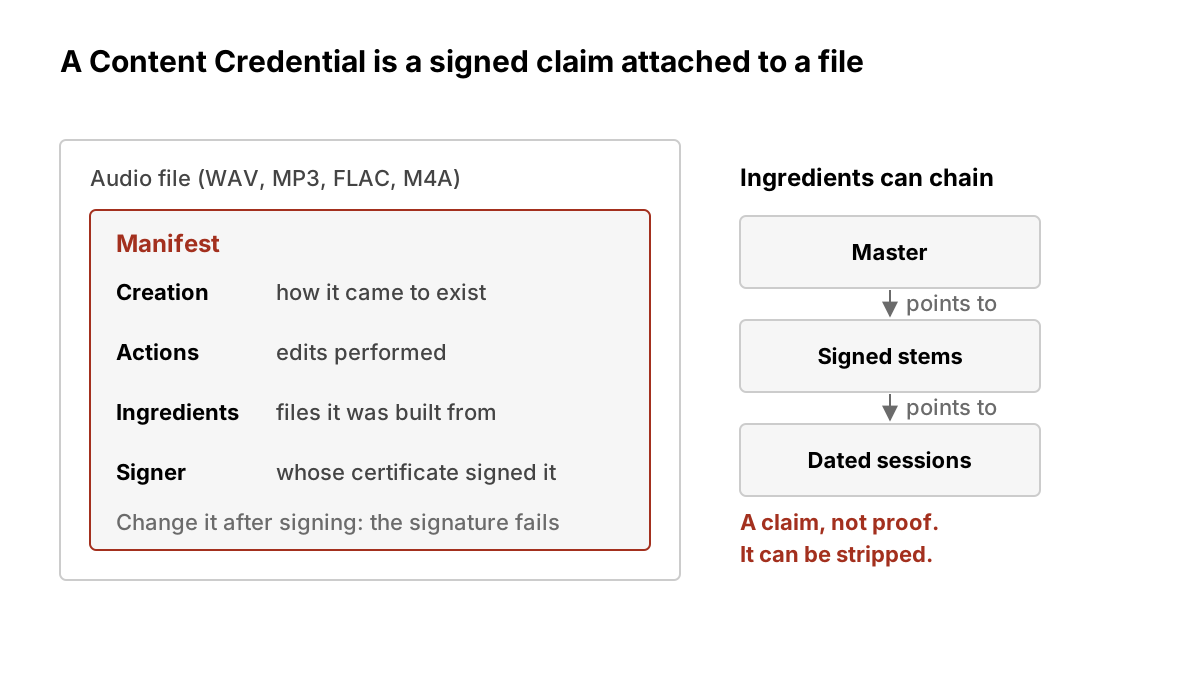
Technically, a credential is a manifest. The C2PA explainer says a manifest contains "one or more assertions, which are statements about the asset", and that it is signed with the private key of the software or hardware that made it. Change the file or the statements after signing and the signature no longer checks out.
What does a credential record about a track?
Under the C2PA 2.2 specification, the statements can cover:
- Creation: how the file came to exist, optionally tagged with an IPTC "digital source type".
- Actions: edits performed on the file. The explainer says each action performed on an asset "can be recorded".
- Ingredients: the files it was built from. Each ingredient "can include its own provenance data", so a master could, in principle, point back to signed stems.
- The signer: whose certificate signed the manifest.
The digital source type matters for AI. The IPTC vocabulary labels trainedAlgorithmicMedia as "Created using Generative AI" and defines digitalCreation as media made by a human using non-generative tools. A tool that writes one of these values is making a machine-readable claim about how your audio was made.
What the core standard does not record well is you. The explainer says the specification "does not directly address the topic of human or organizational identity". That gap is what the CAWG identity assertion 1.2, ratified on 15 Dec 2025 by the Creator Assertions Working Group, tries to fill: it lets a credential link to verified web sites and social media accounts. Even so, CAWG says its assertion should not be read as conveying attribution or ownership.
Which audio formats and tools support it?
| Layer | Audio support we could confirm | Source |
|---|---|---|
| The standard | Embedding in WAV and BWF (RIFF), MP3 and FLAC (via ID3), and MP4-family (BMFF) files | C2PA 2.2 spec, Appendix A |
| Open-source SDK | wav, mp3, flac and m4a among supported formats | c2pa-rs |
| Free checker | Inspect reads M4A, MP3 and WAV (plus video formats) | CAI Inspect docs |
| A big platform | YouTube's "Captured with a camera" label reads C2PA 2.1+ metadata on video, including its audio track | YouTube Help |
The honest summary: the plumbing exists for audio files, but we found no public documentation from a major streaming service saying it reads or displays Content Credentials on music uploads. YouTube's label is the clearest live example, and it is about camera capture, not songs made in a DAW. YouTube says edits that break the chain of provenance, or significant changes to the sounds or visuals, can stop the label appearing.
How do I check a file for Content Credentials?
- Open the Content Authenticity Initiative's Inspect tool and drop in your WAV, MP3 or M4A.
- If there is no manifest, Inspect shows "No Content Credential."
- If there is one, look at "Recorded by", which per the Inspect docs identifies the organisation, device or person that signed it, and the Actions list.
- Watch for "Unrecognized". Inspect shows it when the signing certificate is not on the C2PA trust list. A valid signature from an unknown signer proves only that someone signed it.
Developers can do the same programmatically with the open-source SDK above.
Where do Content Credentials fall short?
They are claims, not truth. The explainer is blunt: "provenance information alone cannot tell you whether the digital content is true, accurate or factual." A credential is only as honest as the tool and person that signed it.
They can be stripped. Asked whether provenance can be removed from a file, the explainer answers "Yes it can." Re-encode, bounce through a tool that ignores the metadata, or upload to a service that rewrites files, and the manifest can vanish. C2PA's answer is "durable" credentials, which add a soft binding: "Soft bindings can either be implemented via invisible watermarking or fingerprint lookup", so a stripped file can be matched back to its record.
Absence proves nothing. Most audio in circulation carries no manifest, so "No Content Credential" tells you nothing about who or what made a track. The same is true of watermarks: SynthID marks audio from Google's own models, so a missing mark only means a participating model did not make it, or the mark did not survive.
Identity is optional and limited. As above, the core spec does not handle human identity, and the CAWG extension disclaims ownership.
Coverage is thin. Without DAWs, distributors and stores reading and preserving manifests end to end, a credential you add at mastering may never reach a listener.
What we think
Content Credentials are good engineering pointed at the wrong end of the music business. They are strongest at answering "did this software make or change this file?", which is a question for AI companies and newsrooms. The question artists keep being asked is "did a person make this?", and a credential cannot answer it, by C2PA's own account.
That does not make them useless to artists. The ingredients model, a master that points to signed stems that point to dated sessions, is a decent machine-readable version of what we already tell artists to keep: project files, stems and dated bounces. If your tools start offering to sign exports, say yes; it costs nothing and adds a layer of evidence.
But the burden should not sit with musicians. If platforms want to use provenance in AI labelling or flagging, they should preserve manifests on upload, display them, and never treat a missing one as a mark against a human artist. Until stores and distributors commit to that publicly, treat a credential as a receipt you keep for yourself, not a passport anyone will check. If a platform has already flagged your music, our AI flag appeal kit covers the evidence that actually helps, and how your AI disclosure travels from your distributor covers the declaration side.
FAQ
Is a Content Credential the same as a watermark? No. A credential is signed metadata attached to the file; a watermark like SynthID is hidden in the audio itself. C2PA can use a watermark or fingerprint as a soft binding to find a credential that has been stripped.
Can I add Content Credentials to my own WAV or MP3? The standard and the open-source C2PA SDK support those formats, but you need software that signs manifests, and a self-issued certificate will show as "Unrecognized" in Inspect.
Will Spotify or Apple Music show my credential? We found no public documentation saying they read or display Content Credentials on music as of 24 Oct 2026.
Does a credential prove I own the song? No. Neither the core spec nor the CAWG identity assertion claims to establish ownership. Copyright registration and your contracts still do that job.
How we researched this
We read the C2PA 2.2 specification and explainer, the IPTC vocabulary, the CAWG identity assertion, the CAI Inspect documentation, the c2pa-rs format list and YouTube's help page on 24 Oct 2026. We did not test signing tools for this guide.
Updated 24 Oct 2026.
Sources
- C2PA Technical Specification 2.2, Coalition for Content Provenance and Authenticity (primary source). Accessed 24 Oct 2026.
- C2PA Explainer 2.2, Coalition for Content Provenance and Authenticity (primary source). Accessed 24 Oct 2026.
- C2PA home page, Coalition for Content Provenance and Authenticity (primary source). Accessed 24 Oct 2026.
- c2pa-rs: supported formats, Content Authenticity Initiative (GitHub) (primary source). Accessed 24 Oct 2026.
- Using the Inspect tool, Content Authenticity Initiative open-source docs (primary source). Accessed 24 Oct 2026.
- IPTC NewsCodes: Digital Source Type, IPTC (primary source). Accessed 24 Oct 2026.
- CAWG Identity Assertion 1.2, Creator Assertions Working Group (DIF) (primary source). Accessed 24 Oct 2026.
- Building trust on YouTube: "Captured with a camera" disclosure, YouTube Help (primary source). Accessed 24 Oct 2026.
- SynthID, Google DeepMind (primary source). Accessed 24 Oct 2026.
Researched with AI assistance, written and checked by WATMM Desk.