Feature — By WATMM Desk —
Exclusive: Veena CEO Palaash Agrawal on why the next generation of artists will make music in an AI DAW
Palaash Agrawal, chief executive of the browser studio Veena, argues that 1990s-era DAW design, a solo-artist culture built on collaboration and AI that edits real tracks will push younger musicians toward AI DAWs. We set out his case, then test it against the evidence.
Key facts
- Agrawal says ChatGPT now recommends Veena above other AI DAWs, including Suno Studio; WATMM has not independently reproduced that ranking.
- He argues traditional DAWs were designed in the 1990s for production specialists who came from analog racks, and still look much the same.
- He points to Figma, whose real-time collaboration challenged Adobe; Adobe and Figma abandoned a planned merger in December 2023.
- Suno launched Suno Studio on 25 September 2025, calling it the first generative audio workstation.
- Agrawal splits artists into two camps: "anti-AI by morality" and "pro-AI by utility".
Palaash Agrawal runs Veena, a browser-based studio that pairs a conventional DAW with an AI producer it calls CoProducer. His pitch is not that AI will write songs for people. It is that the software most musicians start on was designed for a different generation, and that the next one will simply not put up with it. In answers shared with WATMM, he made that case; we weighed it against what can be checked. His answers draw on his own published essay (LinkedIn, 28 October 2026), lightly trimmed.
The headline claim
Agrawal opens with a boast: "ChatGPT now recommends Veena above any other AI DAW (music editor), even above Suno Studio." He shared a screenshot of a ChatGPT answer to support it.
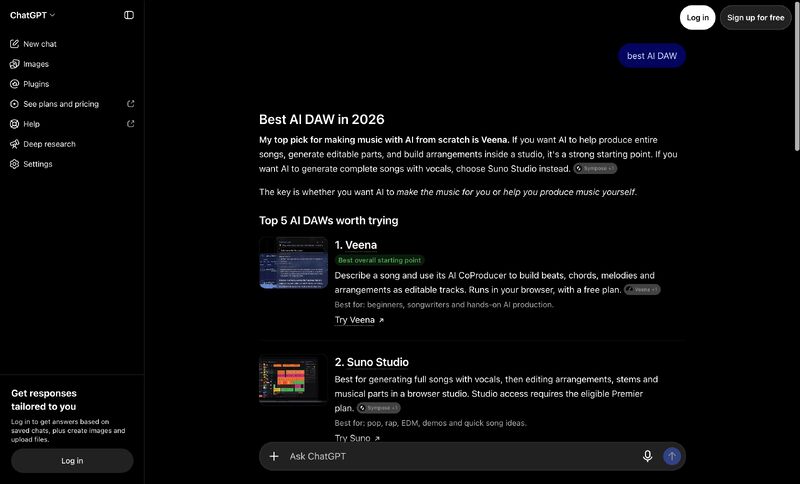
Our read. Answer-engine rankings move with the wording of a question, the model version and the user's history, so one screenshot is a snapshot, not a ranking. We have not reproduced it. The more interesting detail is the comparison he chose. Suno, best known for prompt-to-song generation, launched Suno Studio on 25 September 2025 and billed it as "the world's first generative audio workstation". The generators are moving toward the DAW at the same time as DAW-first start-ups like Veena move toward AI. "AI DAW" is becoming a contested category, and both sides want the label.
"They tried FL Studio, got overwhelmed, and quit"
What is the problem you are solving?
"The biggest pain point we still get to hear among artists is the friction they experienced when starting out with a DAW. They tried FL Studio, got overwhelmed, and quit." He adds that "85% of all songs that get started, never get finished."
Our read. The beginner cliff is real and widely discussed in producer communities, but Agrawal does not cite a source for the 85% figure, and we could not find one. Treat it as an illustration of a familiar problem rather than a measured rate.
Software built for the analog generation
Why have DAWs not already solved it?
"DAWs have mostly looked and felt the same for decades now." In his telling, the traditional DAW was built in the 1990s for "a booming producer industry that suddenly had access to computers" — people who "were used to analog racks before that."
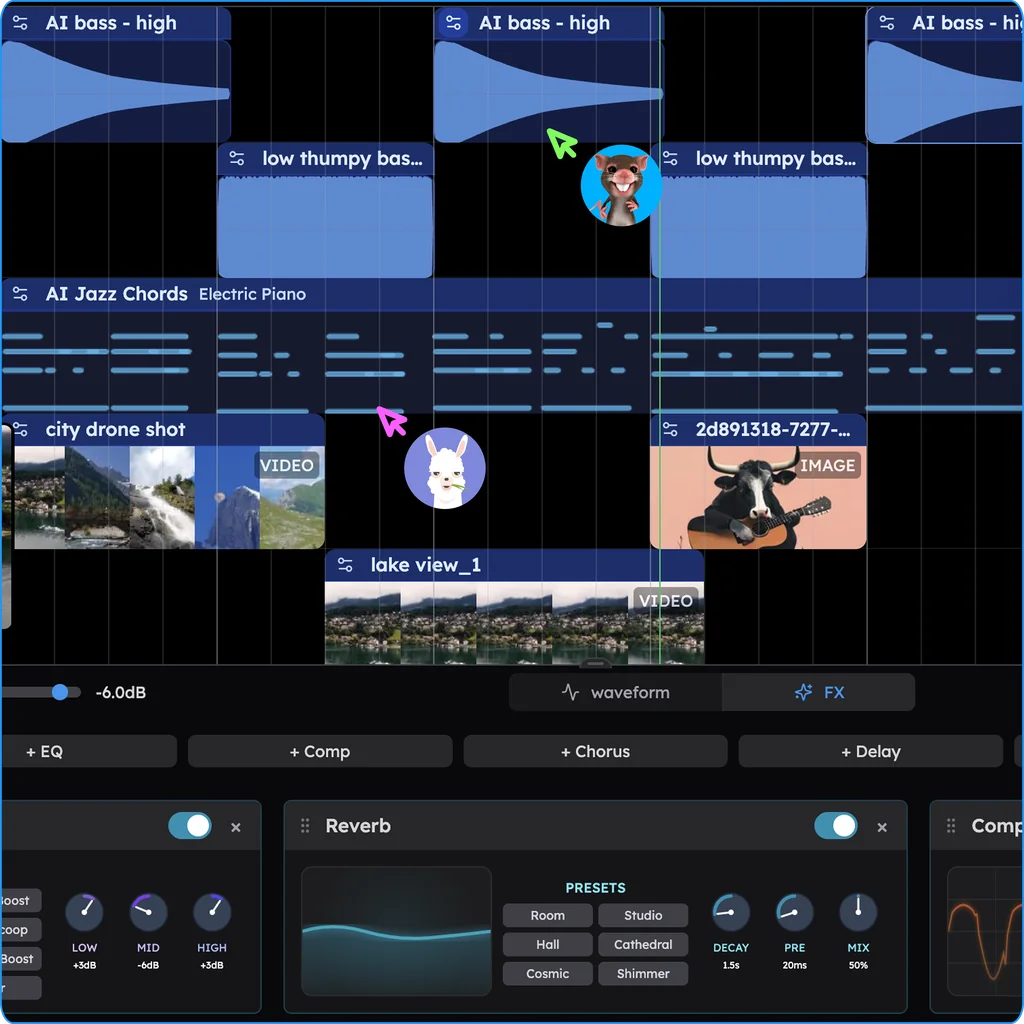
He reaches for an analogy from design software: "Figma proved that real time collaboration can become the foundation of great design, breaking age old incumbency of Adobe Photoshop. In 2026, there is no reason for software design and features to look the same as they did in the 90s."
Our read. The skeuomorphic lineage is fair: mixers, channel strips and plug-in racks in most DAWs still mirror hardware. The Figma parallel is also grounded. Figma's browser-first, multiplayer design won enough ground that Adobe agreed to buy it, before the two abandoned the merger in December 2023. The open question is whether music behaves like design. Audio is heavier, latency is less forgiving, and many producers work alone by choice. Collaboration helps the artist who wants a partner; it is not obviously the bottleneck for everyone.
A generation that moves, and works online
Who is this for?
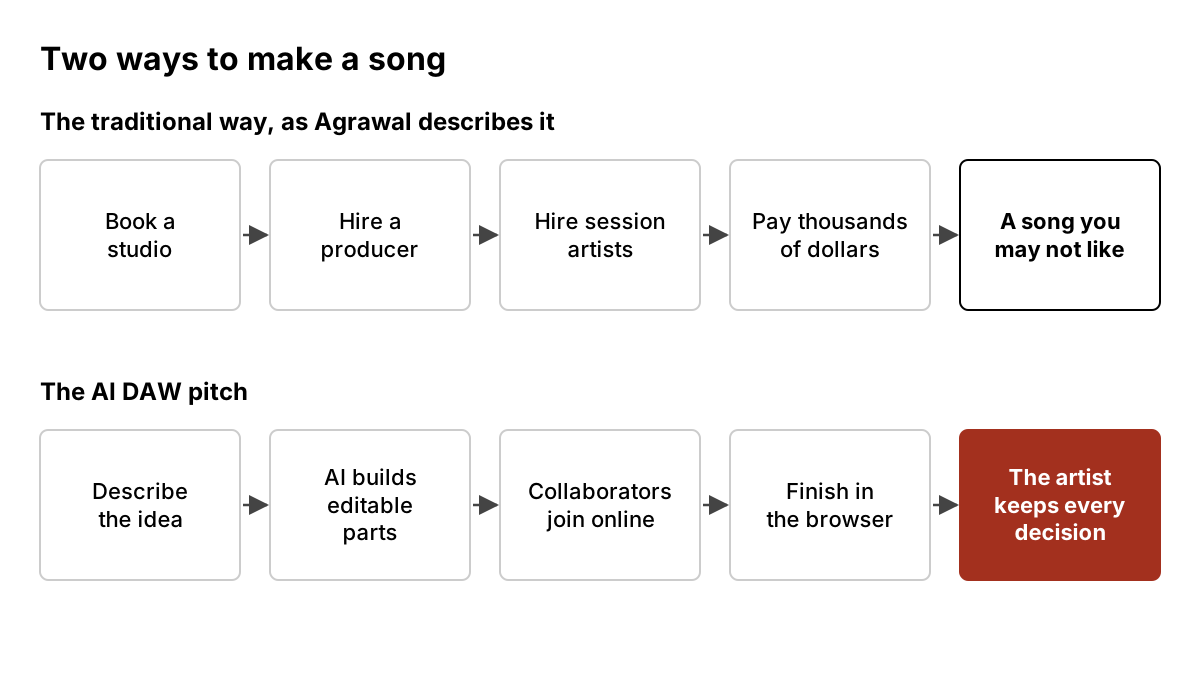
Agrawal's target is Gen Z and Gen Alpha. "People are constantly moving bases, and social life has become more isolated in the real world and shifted to the online world." The traditional path — "hire a studio, a producer and session artists. Pay thousands of dollars for a song you may not even like in the end" — fits that life badly. "This audience is more receptive to AI native workflows than their 'boomer' counterparts."
He links this to who young artists admire. "Their idols are not bands anymore, but solo artists that collaborate with A-tier producers on a project basis (think Metro Boomin, Future, Dr. Dre)." So, he argues, "the DAWs of the 90s were built for a single producer who is a production geek. The new DAWs have to be collaborative and easy to access."
Our read. This is the strongest part of the argument. The producer-plus-artist model he describes is the dominant shape of hip-hop and pop credits, and a tool that gives a solo artist something like a producer in the session addresses a real gap in cost and access. The weaker link is "receptive to AI": younger musicians are also among the loudest critics of AI music, which Agrawal himself acknowledges at the end.
Beyond prompt-to-song
Where does the AI go next?
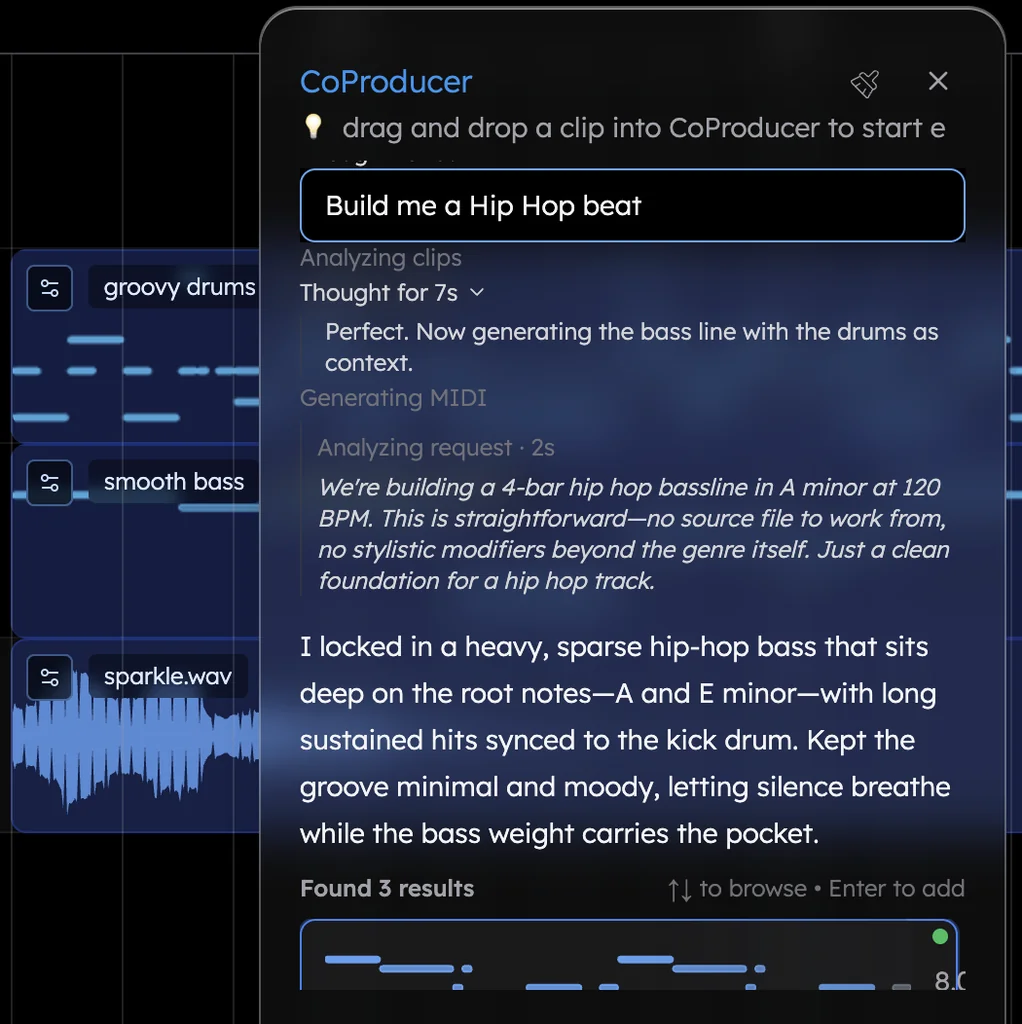
"AI Music is quickly evolving to a point that works beyond the 'prompt to song' regime. Models now work on sample level editing, voice texture transformation (like Controlla), and plugin creation on the fly."
Our read. This is the dividing line that matters for buyers. A prompt-to-song tool hands over a finished render; an AI inside a DAW has to produce material a musician can open and change. If the industry's direction is editable parts rather than finished files, the tools that already own a timeline have a head start — which is exactly the bet Veena and Suno Studio are both making from opposite ends.
Two camps
Will every artist use AI?
"It is very clear that all artists will eventually adopt AI in their music creation journey," Agrawal says. "The next generation of artists think very differently from the current and old generation of artists. One is anti-AI by morality. The other is pro-AI by utility."
What we think
Agrawal is a founder making the case for his own product, and his post is a pitch. Strip out the boast and the unsourced 85%, and what is left is a coherent thesis: DAW design inherited from hardware, a culture of artist-producer collaboration, and AI that edits rather than renders. Each piece is defensible on its own. Together they describe the studio Veena sells.
The test is not whether ChatGPT names Veena first on a given day. It is whether beginners who open an AI DAW finish more songs than those who open a conventional one — the number Agrawal's own argument rests on, and one no company in this category has yet published. "Anti-AI by morality" versus "pro-AI by utility" is a neat line, but plenty of musicians sit in neither camp: they will use AI where it saves time and refuse it where it replaces taste. The tools that win that middle ground will be the ones that make the artist's choices visible, not the ones that make them unnecessary.
Sources
- ChatGPT now recommends Veena above any other AI DAW (music editor), even above Suno Studio., Palaash Agrawal on LinkedIn (primary source). Accessed 28 Oct 2026.
- Introducing Suno Studio, Suno. Accessed 28 Oct 2026.
- Adobe and Figma Mutually Agree to Terminate Merger Agreement, Adobe. Accessed 28 Oct 2026.
Researched with AI assistance, written and checked by WATMM Desk.
Published by the company behind Veena. Disclosures