Learn — By WATMM Desk —
A six-week release timeline: pitching editors beyond Spotify through your distributor
Spotify lets you pitch yourself a week before release, but Apple Music, Amazon Music and Deezer editors mostly hear about your song through your distributor, and distributors want weeks of notice. Here is a six-week plan built backwards from the deadlines distributors publish, as we read them on 24 Oct 2026.
Key facts
- Spotify: deliver and pitch at least 7 days before release to be considered and to land in followers' Release Radar; one unreleased song can be pitched at a time.
- Distributor deadlines are longer: Identity Music recommends 6 weeks for Apple Music, Amazon and Deezer (absolute deadlines 4, 4 and 2 weeks), EmuBands asks for at least 5 weeks, and iMusician needs a release date at least 20 working days out.
- Distributor pitching is not a guarantee: iMusician says opting in means its playlist team will listen, and Identity Music warns that paying for playlist placement breaks most platforms' terms.
Most release advice is really Spotify advice. That makes sense, because Spotify is the one big service that lets you pitch an unreleased song to its editors yourself, from Spotify for Artists. But Apple Music, Amazon Music and Deezer have editorial teams too, and for most independent artists the route to them goes through a distributor. Distributors want much more notice than Spotify's seven days.
This guide builds a six-week timeline backwards from those distributor deadlines. If you only want the Spotify form, our guide to writing the 500-character Spotify pitch covers it, and our one-page release checklist links the paperwork steps such as rights, credits and mastering. Everything below is as we read each page on 24 Oct 2026. Distributors change their rules, so check your own distributor's help pages before you set a date.
Why six weeks
Here are the deadlines, taken from each company's own pages.
Spotify. Spotify's pitching page says to deliver your music at least 7 days before release so editors have time to listen. If you pitch an unreleased song at least 7 days before release, Spotify adds it to your followers' Release Radar playlists. You can pitch only one song at a time, and you can pitch the next one once that song goes live.
Identity Music publishes the most detailed table we found, on its pitching help page:
| Platform | Recommended | Absolute deadline |
|---|---|---|
| Amazon | 6 weeks | 4 weeks |
| Apple Music | 6 weeks | 4 weeks |
| Deezer | 6 weeks | 2 weeks |
| Spotify | 4 weeks | 2 weeks |
EmuBands says on its pitching FAQ that playlist pitching needs a minimum of 5 weeks' notice, and that pitches with less than 4 weeks' lead time often have lower chances.
iMusician says in its pitching FAQ that your digital release date must be at least 20 working days after you select it, so its team has time to review the track. That is about four calendar weeks.
Notice that the distributor deadlines for Spotify are longer than Spotify's own. A distributor needs time to read your pitch, edit it and pass it on. Six weeks is the longest recommended lead time on these pages, so it is the safe default if you want every editorial team to hear the song.
What each distributor actually does
The services differ in how you ask and what it costs.
- Identity Music: you send a pitch request through a form linked in your welcome email. Its team polishes the pitch and submits it to the platforms you choose. The page names the free-text limits as Spotify 500 characters, Apple 600, Amazon 1,000 and Deezer unlimited. It adds that on Amazon only one track per release can be pitched, though several pitches can be live at once. It does not list a price.
- iMusician: you switch on "Editorial playlist pitching" in the Delivery section while you create the release, then pick a focus track. It is included on the AMPLIFY+ and AMPLIFY Pro plans and costs 20 per release on the AMPLIFY and Starter plans (the page gives no currency symbol next to the figure). You can have only one release in its pitching process at a time, and it asks you not to also pitch that release yourself through Spotify for Artists. It says the service suits artists who already have releases with some streams, and may not suit a first release.
- EmuBands: you contact your account manager, which needs a Pro or Premium plan. It only pitches brand-new, unreleased music. Any earlier public release disqualifies a track. It asks for a private streaming link that stays live until release.
Two lessons carry across all three. First, read the rules on doubling up: iMusician asks you not to self-pitch on Spotify alongside its own pitch, so check whether your distributor does the same before you file the form twice. Second, your "single" must be new. A track you already put out, even on another release, is out at EmuBands and cannot be iMusician's focus track.
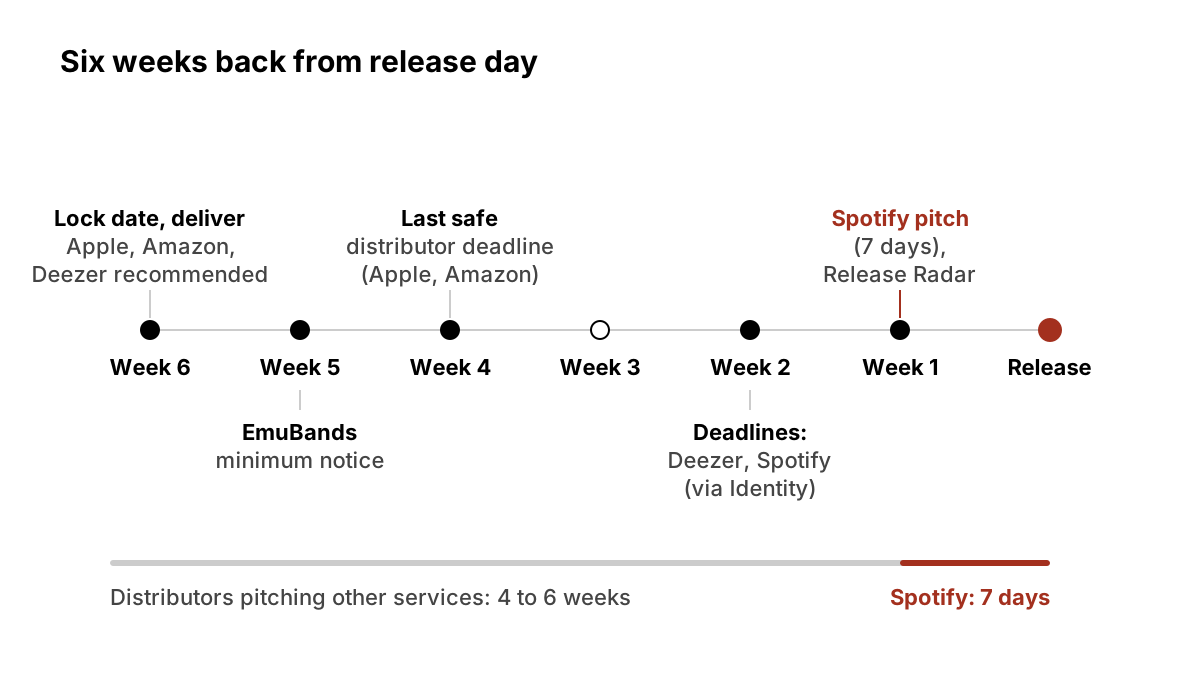
The six-week checklist
Count back from release day (R).
Week 6 (R minus 42 days): lock the date and deliver.
- Finish the master, artwork and metadata before you book the date. You cannot pitch what your distributor does not have.
- Pick the release date in your distributor at least six weeks out. On iMusician the floor is 20 working days; aim past it.
- Choose one focus track. Spotify takes one pitch at a time, Amazon one track per release at Identity Music, and iMusician one focus track.
- Turn on, or request, editorial pitching now. Identity Music recommends six weeks for Apple Music, Amazon and Deezer.
Week 5 (R minus 35): write the pitch once, well.
- Draft a long version and cut it to each limit: 1,000 characters for Amazon, 600 for Apple, 500 for Spotify, per Identity Music.
- Lead with the story. EmuBands and Identity Music both ask for the inspiration, how and where it was made, and what it means. Identity Music says to open with your strongest line.
- Write the promotion plan in specifics: press, radio, shows, videos, ads. Both distributors ask for it.
- List similar artists, as EmuBands asks, and have a private streaming link ready that stays live until release.
- EmuBands' minimum notice is five weeks. Get the pitch to them by now.
Week 4 (R minus 28): last safe distributor deadline.
- Identity Music's absolute deadline for Apple Music and Amazon is four weeks. EmuBands says pitches under four weeks often do worse. Treat this as the last day to send distributor pitches for those services.
- Check that metadata matches the pitch: genre, mood, instruments and lyric language are the fields Identity Music says the platforms ask for.
Week 3 (R minus 21): build the rest of the release.
- Plan the content you said you would make in your pitch. Editors read the promotion plan as a promise.
- If your release is an album or EP, our guide to Spotify Countdown Pages and pre-saves covers who qualifies and how to set one up.
Week 2 (R minus 14): final deadlines.
- Identity Music's absolute deadlines for Deezer and Spotify fall here.
- Confirm the release appears in Spotify for Artists as upcoming, so you can pitch it yourself if your distributor allows that.
Week 1 (R minus 7 or earlier): Spotify's own cut-off.
- Pitch on Spotify for Artists at least 7 days before release, unless your distributor is pitching Spotify for you and asks you not to. Seven days is also the Release Radar cut-off.
- After this point, nothing you do on the pitch side changes release day.
Release day and after.
- Once the song is live you can pitch your next unreleased song on Spotify. At iMusician the next release can only be pitched once this release date has passed.
What not to do
Do not buy playlist placements. Identity Music's page says paying for playlist features is against the terms of service on most platforms and is likely to do more harm than good. It also says nobody can guarantee a placement. iMusician is careful in the same way: opting in, it says, ensures its playlist team will listen to your music, not that the song will be pitched or placed.
Do not let follower counts put you off. Identity Music reports that, according to Spotify, follower counts, monthly listeners, radio plays, blog coverage and label status don't affect whether a pitch succeeds. iMusician's caution that its service may not suit a first release is a separate point about its own team's filter. It is not a platform rule.
What we think
The useful fact here is the gap. Spotify asks for a week. The distributors who pitch Apple Music, Amazon and Deezer for you ask for four to six. Artists who plan around Spotify's seven days are quietly opting out of every other editorial team, and most of them never learn that this was a choice.
So we would set six weeks as the default for any single you care about, even if you only ever self-pitch on Spotify. The extra time costs nothing if your master is finished, and it is the only way to keep the other services open. If your master is not finished six weeks out, move the date rather than the pitch.
We would also be honest with ourselves about the odds. None of these pages promises a placement, and the one sure return on Spotify is Release Radar for people who already follow you. The long lead time is worth it mainly because the work it forces, a finished master, a clear story and a real promotion plan, is the work that helps the release whether or not an editor says yes.
Finally, read your distributor's pitching page before you choose one, not after. Whether pitching is included, costs extra or needs a higher plan differs a lot between the three we read. That is a better reason to pick a distributor than most of what goes on their homepages.
Sources
- Pitching music to playlist editors, Spotify for Artists Support (primary source). Accessed 24 Oct 2026.
- Editorial Playlist Pitching, Identity Music Help Centre (primary source). Accessed 24 Oct 2026.
- What's editorial playlist pitching?, iMusician (primary source). Accessed 24 Oct 2026.
- Pitching: what you need to know, EmuBands (primary source). Accessed 24 Oct 2026.
Researched with AI assistance, written and checked by WATMM Desk.